
Archer, Joby, and the Shenzhen Connection
Profile, funding, and patents.

Video: TBPN. The larger video can be viewed here on YT at 1:47:35 (Here’s hoping Archer doesn’t go after Taylor Swift—her Swifties might be the toughest competition yet. Disclaimer: That was a joke).
Author's note — The below data presented was gathered from publicly available government sources. The compilation of subsidy records, financial details, and patent information was researched and assembled by the author.
The discussion of legal frameworks is provided for informational context only and does not constitute legal advice.
If you find this useful for reporting or analysis, please attribute it to Jennifer Meszaros, China eVTOL News.
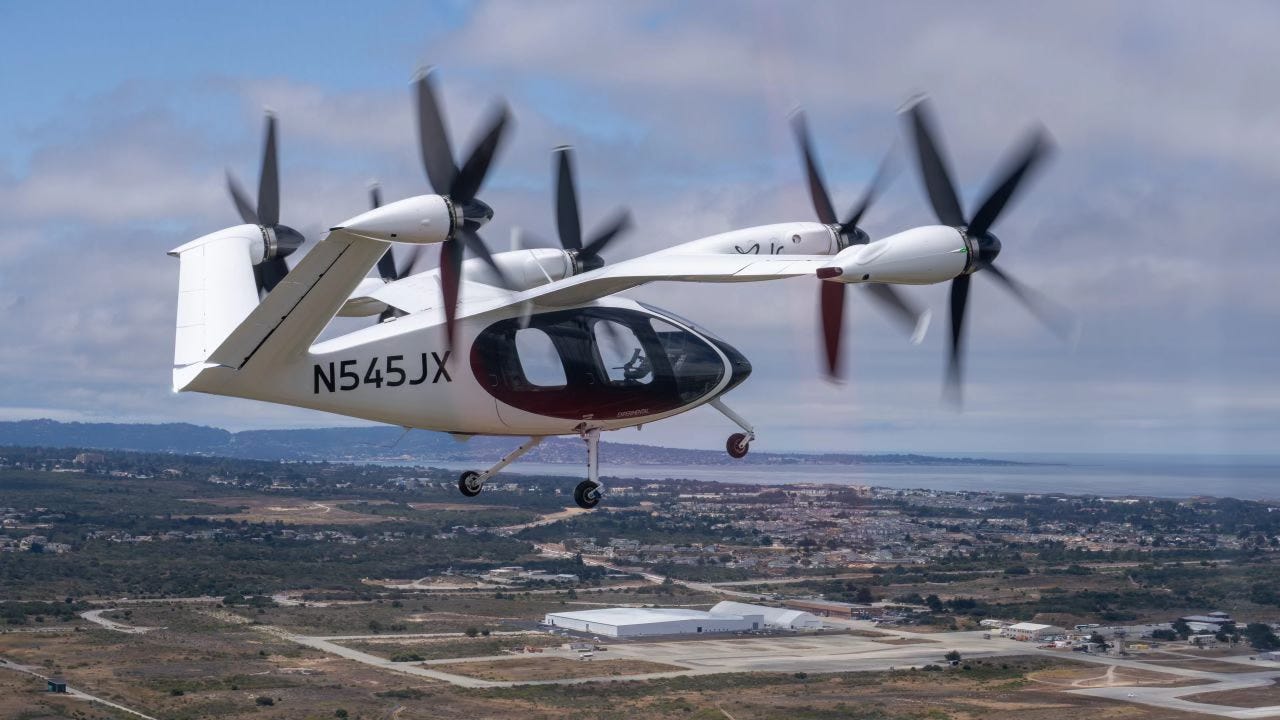
As readers may be aware, Archer Aviation has filed a counterclaim against Joby Aviation alleging the company misled federal regulators and investors by concealing ties to Chinese suppliers and its Shenzhen subsidiary, which reportedly received technology-development grants from the Chinese government.
Filed on March 9 in a federal court in California, the lawsuit argues that the connections contradict Joby’s branding as an “American-made” air-taxi manufacturer and raise national-security concerns.
Archer alleges that Joby secured at least $131 million in U.S. Air Force contracts while promoting its aircraft as “Committed to American Innovation.”
The counterclaim also claims Joby misclassified aerospace imports from the subsidiary as items such as socks, napkins, hair clips, and photo albums — a practice Archer says allowed the company to evade U.S. tariffs, distort competition, secure government contracts, and bypass national-security oversight.
Archer is seeking damages and a court order blocking what it describes as unfair competitive practices.
According to Reuters, Joby’s attorney, Alex Spiro, responded by dismissing the claims as baseless.
The counterclaim follows an earlier lawsuit filed by Joby last November alleging that Archer misappropriated trade secrets related to eVTOL aircraft technology. Joby’s lawsuit claims that trade secrets taken by a former employee were later used by Archer in an effort to secure a competing deal with a real estate developer.
Archer has denied the allegations, stating that its aircraft were independently developed.
Archer is also pursuing legal action against UK-based Vertical Aerospace, arguing that the design of Vertical’s Valo aircraft infringes on intellectual property associated with Archer’s Midnight aircraft.
Vertical Aerospace has rejected the claims, saying similar aircraft designs are common across the industry due to aerodynamic and engineering constraints.
Unfortunately, I had difficulty accessing Archer’s counterclaim directly. My Canadian information was not accepted by the Public Access to Court Electronic Records (PACER) system.
I prefer to review filings and supporting evidence myself, but in the absence of that, Aerospace Global News has published examples of import classifications cited in Archer’s counterclaim against Joby.
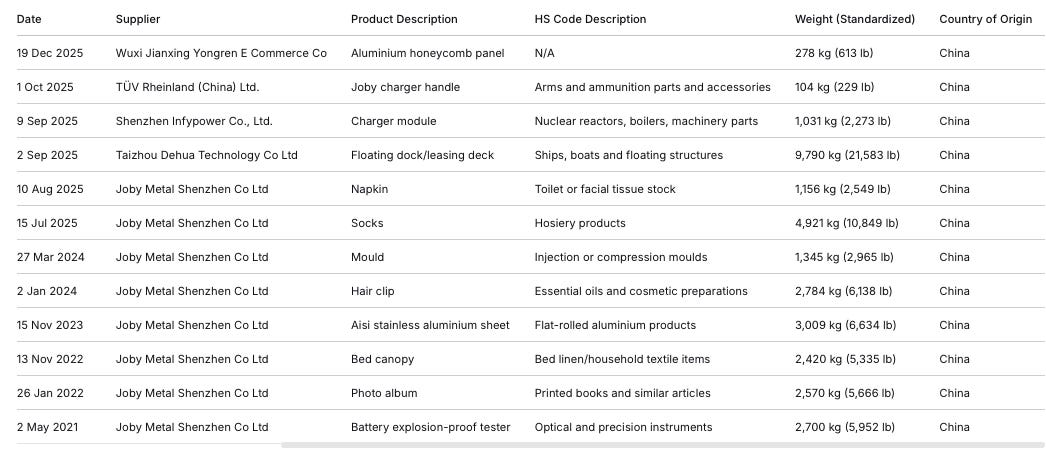
According to the outlet, the filing references a range of shipments from Chinese suppliers between 2021 and 2025.
These include items such as an aluminium honeycomb panel from Wuxi Jianxing Yongren E Commerce Co in December 2025 (278 kg), a charger module from Shenzhen Infypower Co., Ltd. in September 2025 (1,031 kg), and a floating dock or leasing deck from Taizhou Dehua Technology Co Ltd the same month weighing 9,790 kg.
Several entries involve shipments from Joby’s subsidiary, Joby Metal Shenzhen Co Ltd that were reportedly classified as consumer goods, including “napkins” (1,156 kg) and “socks” (4,921 kg) in 2025, along with earlier shipments labelled as “hair clips,” “bed canopy,” and “photo album” between 2022 and 2024.
The cited records also include industrial items such as moulds, aluminium sheet, and a battery explosion-proof tester.
Some of the companies referenced have identifiable corporate presences. For example, Shenzhen Infypower Co., Ltd.maintains a public website, while TÜV Rheinland (China) Ltd. operates as a subsidiary of Germany’s TÜV Rheinland Group.
Joby has operations in Germany (Munich and Stuttgart), Austria (Linz), Costa Rica (San Jose), and China (Shenzhen).
Before, we look at Joby’s subsidiary, Joby Metal Shenzhen Co Ltd., —-
I prepared this article yesterday and, after my interview with Zag Daily, held off publishing it so this report could provide additional context and detail.
In my comments to Zag Daily, I noted that Joby Metal Shenzhen is not a secret. The company, wholly owned by Joby Motors, LLC, has been registered since 2012 and disclosed in SEC filings for years.
No U.S. law broadly prohibits American companies from maintaining subsidiaries in China or for those subsidiaries to receive ordinary local business incentives.
Rather, U.S. and foreign firms operating in China may establish locally registered subsidiaries eligible for the same economic development programs available to any local company.
Regarding claims that aerospace imports were misclassified, at the time of writing, I have no access to customs records or shipping data. Public records reviewed for this article — including business registration, subsidy notices, patent filings, and SEC disclosures — do not address this aspect of the litigation.
Update:

Beyond the specifics of import classifications, a broader legal question for any US aerospace firm with Chinese operations is whether restricted technology or technical data has been transferred without authorization in violation of export controls such as the International Traffic in Arms Regulations (ITAR) or the Export Administration Regulations (EAR).
A recent example is the case of RTX Corporation, which in August 2024 reached a $200 million settlement with the U.S. Department of State’s Directorate of Defense Trade Controls (DDTC) for hundreds of alleged violations of the Arms Export Control Act (AECA) and ITAR, including unauthorized exports of technical data and defense components to multiple foreign destinations, including China, between 2014 and 2023.
Joby Metal Shenzhen Co Ltd
Joby Metal Shenzhen was established on February 9, 2012, and its registration status is recorded as existing (in operation).