
COMAC and Deer Jet Launch CBJ Operations
2026 marks the tenth anniversary of C909 commercial operations,

COMAC and Deer Jet announced today the official commercial entry into service of the world's first COMAC Business Jet (CBJ), with a maiden charter flight operating from Shanghai Hongqiao to Beijing Capital Airport on June 22.

The CBJ is a derivative of COMAC's C909 regional jet, originally designated the ARJ21‑700.
The ARJ21‑700 airframe received type certification in 2014. The CBJ configuration received its Validation Type Certificate in March 2021.
Seating capacity ranges from 12 to 29 passengers, with typical configurations accommodating 12 to 19 seats.
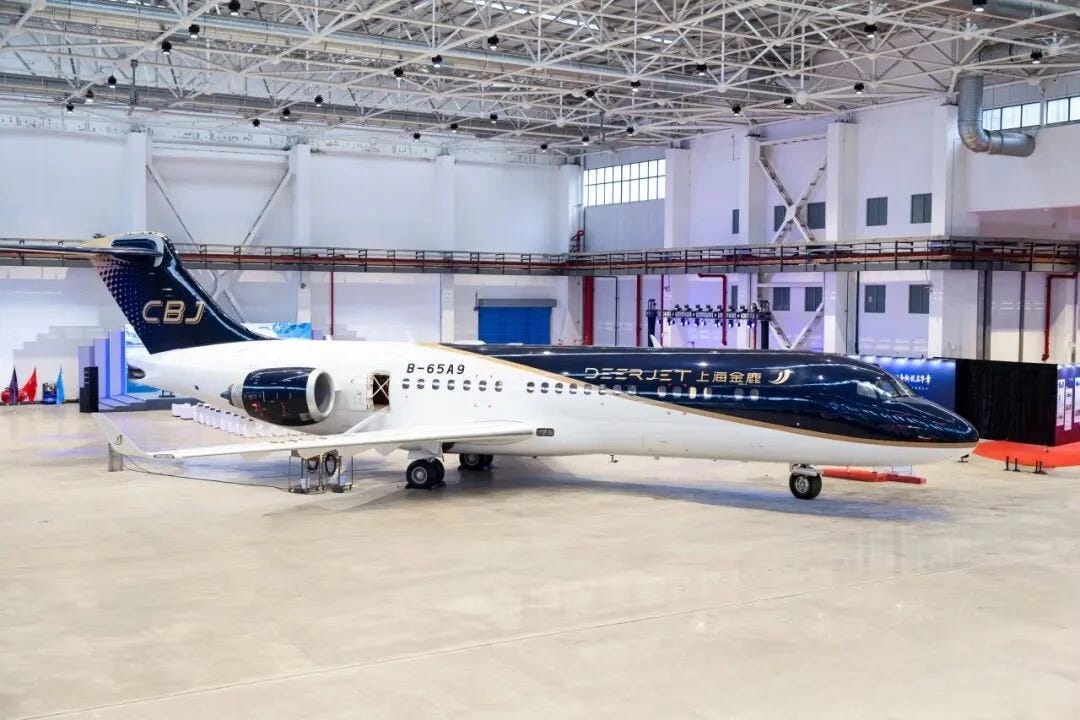
The CBJ measures 33.5 m (110 ft) in length with a 27.3-m (89.5 ft) wingspan and stands 8.4 m (27.6 ft) tall.
Its 19-m (62.4 ft) cabin—3.14 m (10.3 ft) wide and 2.03 m (6.7 ft) high—aims to provide more volume than typical large-cabin business jets, supported by over 3.5 m³ (124 ft³) of dedicated interior luggage space and more than 20 m³ (706 ft³) of cargo capacity.
Powered by two GE CF34-10A engines, like its regional jet predecessor, each rated at 17,410 lb. thrust, the aircraft cruises at Mach 0.78 and typically operates at 35,000 ft. (10,668 m), with a certified ceiling of 39,000 ft. (11,887 m).
At maximum takeoff weight of 43,500 kg (95,900 lb), the CBJ requires a 2,049-m (6,722 ft) takeoff roll and 1,779 m (5,837 ft) for landing, operating within a 5,000-km (3,107 mi) range under standard conditions with eight passengers.
The aircraft offers a typical flight endurance of five hours, with optional supplementary fuel tanks available.
Designed for high-altitude performance, the CBJ is validated to operate at airfields up to 4,411 m (14,470 ft), including Daocheng Yading Airport—the world’s highest civilian airport, and is optimized for plateau and high-temperature operations.

COMAC offers a range of customizable cabin configurations to suit different operator needs.
Plan A seats 15 passengers with 11 luxury seats, two couches, two business-class seats, a VIP suite, two lavatories, and two crew seats.
Plan B accommodates 13 passengers with six couches, five luxury seats, two business-class seats, a VIP suite, two lavatories, and one crew seat.
Plan C maximizes lounge space for 17 passengers with 12 couches, three luxury seats, two business-class seats, a VIP suite, two lavatories, and one crew seat.
Plan D seats 18, balancing nine luxury seats, three couches, six business-class seats, nine flat-available seats, a VIP suite, two lavatories, and one crew seat.
The largest layout, Plan E, supports 29 passengers with 22 business-class seats, four luxury seats, three couches, two flat-available seats, a VIP suite, two lavatories, and two crew seats.

Across all configurations, the CBJ features a full VIP suite with a 1.5-m (4.9 ft) double bed and private lavatory, a reception area with lie-flat first-class seats, and a meeting/dining area with an eight-seat table and satellite phone.
The rear cabin includes a bar, coffee station, oven, and steward seat, while sound insulation keeps noise levels as low as 55 dB in the VIP suite and below 65 dB elsewhere.
Optional phased-array broadband satcom provides high-speed internet and cockpit-cabin connectivity, and foldable boarding ladders enhance operational flexibility at airports without jet bridges.
As expected, the aircraft integrates systems from global suppliers beyond GE Aerospace, including Rockwell Collins (avionics system), Liebherr (air management, landing gear, anti-icing, and air supply systems), Parker (fuel system, hydraulic energy systems, and actuation system), Hamilton Sundstrand (electronic system, flap and slat system, APU, and PFC for rudder, elevator, aileron, and interceptor), FACC (winglets), Eaton (fuel casing system and control panel and lights control system), Kidde Aerospace (fire-protection system), and Goodrich (lighting system).
COMAC has emphasized domestic support, offering 24/7 technical assistance, on-site representatives, and integrated maintenance planning, along with potential tax and operational advantages for Chinese operators.

Statements from parties —
Ding Yongzheng (丁拥政), Senior Vice President of Liaoning Fangda Group and Chairman of HNA Aviation Group, stated that the CBJ commercial maiden voyage represents a step in the serialized development of domestically produced civil aircraft, aligning with the operational deployment of both C909 passenger jets and business derivatives.
He noted that the operator plans to focus on safety, operations, and international expansion, leveraging the C909’s existing support framework and HNA Aviation Group’s global route resources.
Yu Shihai (于世海), Chief Accountant of COMAC, stated that the C909 platform has accumulated over 1 million safe flight hours over ten years, with 185 aircraft delivered to date, carrying more than 36 million passengers across 12 countries.
He noted that the Asia-Pacific business aviation market is currently in a new development cycle, and that COMAC intends to work with Deer Jet on safety, market expansion, and industrial ecosystem development, with the aim of extending CBJ operations along the Belt and Road routes.
Zhou Wei (周伟), President of Deer Jet Business Jet Group and Chairman of Shanghai Deer Jet, stated that Deer Jet plans to utilize its integrated capabilities in charter, management, maintenance, and ground support to introduce customized products for high-net-worth individuals and corporate fleets.
The objective is to achieve scaled operations in the domestic high-end travel segment.
Looking forward, Deer Jet said it will continue to collect and share operational data, customer feedback, and market intelligence with COMAC to refine support systems.
Both parties plan to conduct joint marketing and customer experience initiatives targeting high-end business travel demand.