
Completes C919 Plateau Variant Maiden Flight
The aircraft, registered as B-002U, remained airborne for nearly two hours.

This article is provided free of charge. Readers are trusted to respect the work herein and are requested not to plagiarize, scrape its content for training large language models, or repurpose it commercially. Thank you for your integrity and respect. For further information, please see the Terms of Use on the home page menu bar.

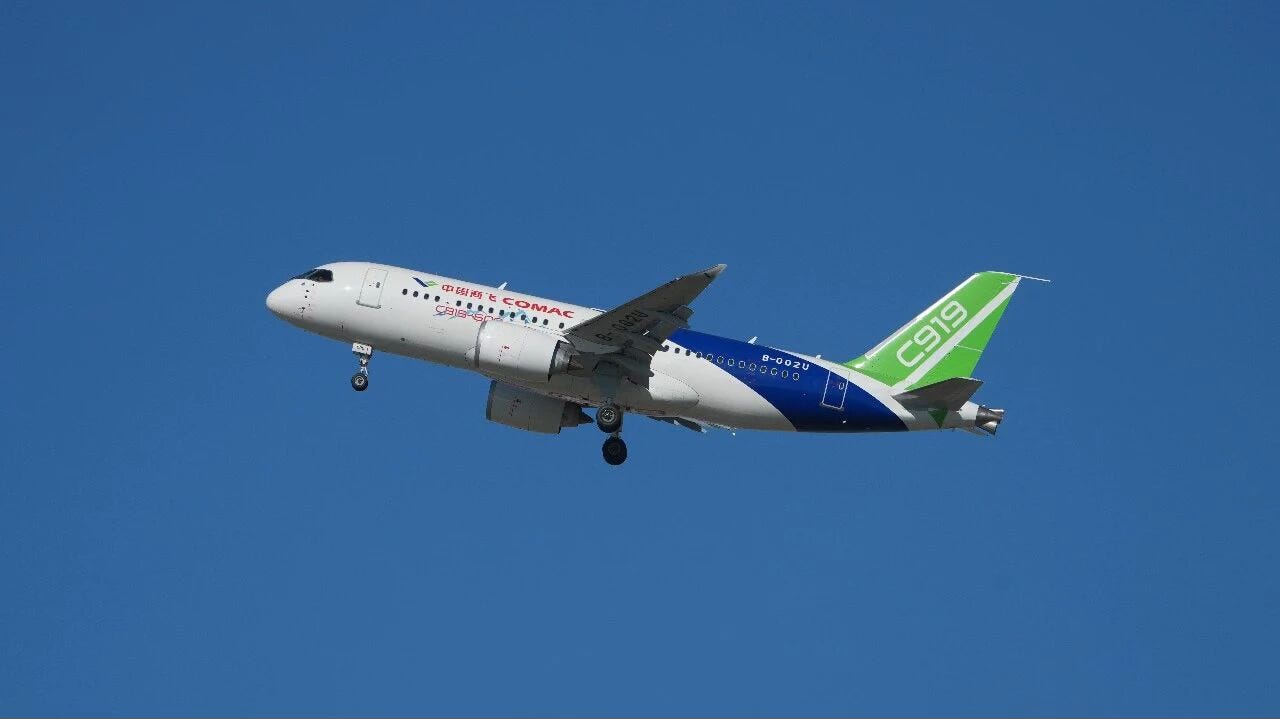
COMAC announced that the first C919 plateau-type aircraft successfully completed its maiden flight on July 29.
The prototype, registered as B-002U (manufacturer serial number MSN 00032), took off from runway 4 of Shanghai Pudong International Airport at 7:59 AM Beijing time.
The aircraft remained airborne for 1 hour and 59 minutes and completed all scheduled test-flight subjects, COMAC said, adding that the successful test flight marks a step forward in the serialized development of the C919 aircraft family.

The plateau variant, internally designated C919-600, is a derivative of the standard C919 model.
COMAC has implemented structural and system modifications including a shortened fuselage – reduced by approximately 3.6 meters (equivalent to six fuselage frames, or about 11.8 feet) to a total length of about 34 meters (approximately 111.5 feet) – and system function improvements to meet operational requirements at high-altitude airports.
The aircraft is configured with 140 to 160 seats and has a range of approximately 3,000 kilometers (about 1,864 miles).
It retains the LEAP-1C engine with weight reductions to improve thrust-to-weight ratio.
Additional modifications include an extended emergency oxygen supply – increased from the standard 15 minutes to 60 minutes – and the installation of Beidou satellite navigation with RNP-AR precision approach capability.
Video: CAAC News
The variant is being developed in cooperation with Tibet Airlines, which has placed an order for 40 aircraft.
The prototype rolled out at COMAC’s Shanghai Pudong base in January and completed low-, medium-, and high-speed taxi tests prior to the maiden flight.
In June, the outer wing box received certification from the Civil Aviation Administration of China.
Following the maiden flight, the prototype will undergo a series of research and test flights over the next year, including environmental adaptability validation at high-altitude airports in Qinghai and Tibet.
According to local media reports, COMAC aims to complete full type certification and enter commercial service by 2028. The manufacturer has not confirmed a timeline.
