
FCourier’s “Airborne Router” Supports Flood Relief in Guangxi
Company press release.

Vertaxi, the parent company of FCourier, shared the following press release with China eVTOL News. It details FCourier's recent emergency deployment of its type-certified E40H UAVs to help restore communications during severe flooding in Guangxi and Fujian.
The English-language press release is available below for editorial use and publication.
FCourier’s “Airborne Router” Supports Flood Relief in Guangxi, Delivering a Critical Communications Lifeline
Following Typhoon Maysak and days of extreme rainfall, severe flooding struck multiple areas across Guangxi, creating “three interruptions” disaster scenarios where power, communications, and road access were simultaneously cut off.
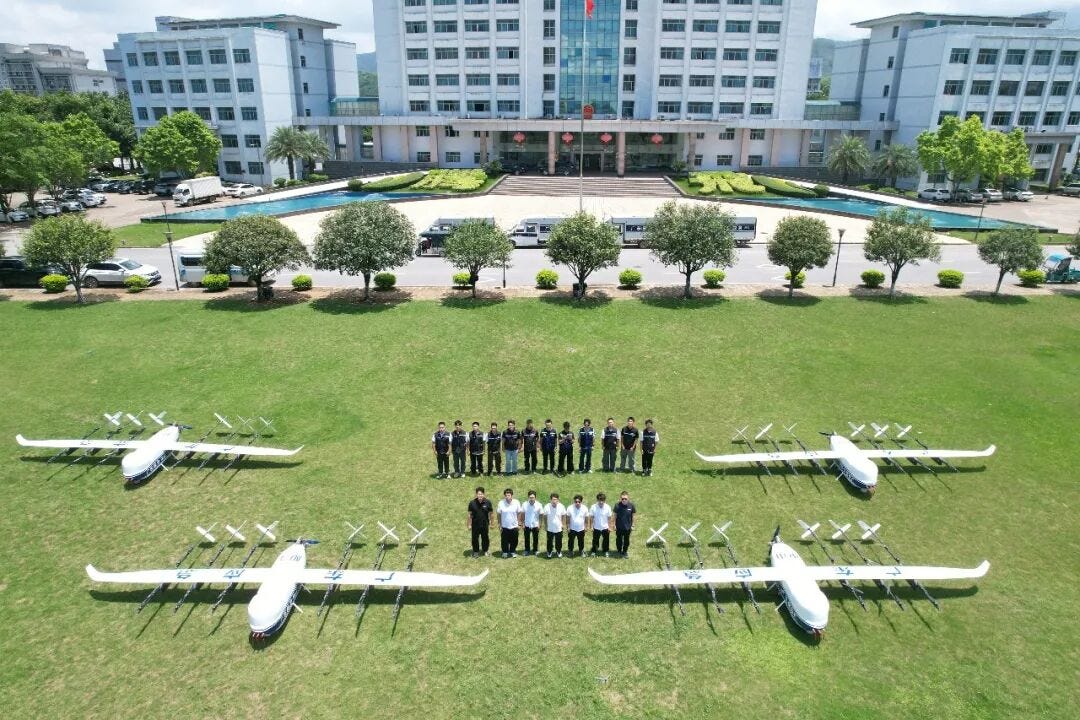
Under the unified deployment of the Guangdong Provincial Department of Emergency Management, FCourier rapidly mobilized its emergency response teams on July 6, dispatching five E40H hybrid-electric VTOL fixed-wing UAVs together with one relay UAV to support disaster relief operations in Guangxi.
While emergency operations were still underway in Guangxi, Typhoon Bavi, the ninth typhoon of the year, brought severe wind and rain to Fujian Province. On July 11, at the request of the Fujian Provincial Department of Emergency Management, the Guangdong Provincial Department of Emergency Management again deployed FCourier’s E40H UAVs to support emergency communications in Fujian, initiating simultaneous cross-provincial operations on two disaster fronts.
Rapid Overnight Deployment Demonstrates Corporate Responsibility
Immediately after receiving the emergency deployment order on July 6, FCourier assembled its emergency response teams overnight.
Five E40H UAV systems departed from Zhanjiang, Maoming, Yangjiang, Jiangmen, and Zhongshan, traveling through the night despite heavy rain to reach eight disaster-affected areas, including Hengzhou, Binyang County, Qintang District, and Qinnan District in Guangxi.
Five UAV teams operated independently while coordinating closely, providing continuous day-and-night emergency communications support and establishing an “airborne router” over disaster zones.
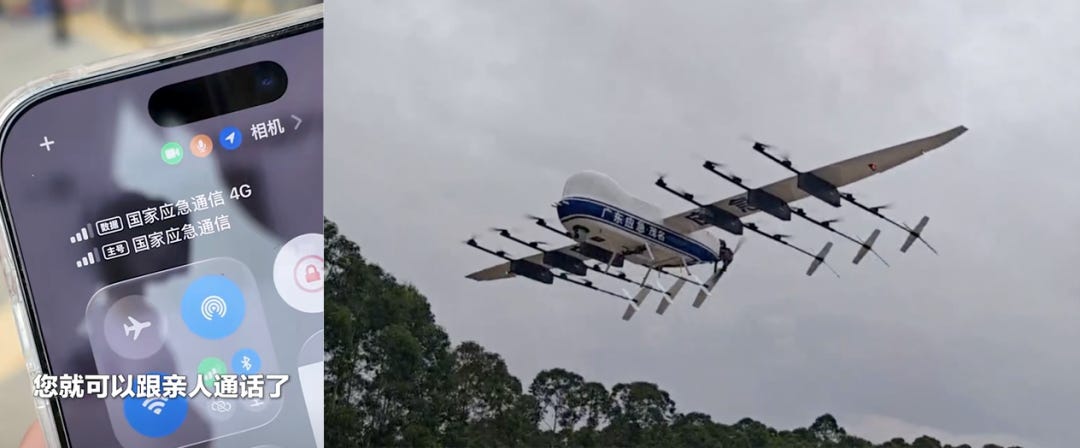
The teams from Zhanjiang and Maoming were the first to arrive. After traveling overnight across provincial borders, they reached Binyang County before dawn on July 7, immediately conducted site surveys, assembled and tested the aircraft, and successfully launched the first mission that morning.
The E40H simultaneously carried out disaster reconnaissance and emergency communications support, enabling residents in previously disconnected areas to reconnect to mobile networks and contact their families for the first time since the disaster.
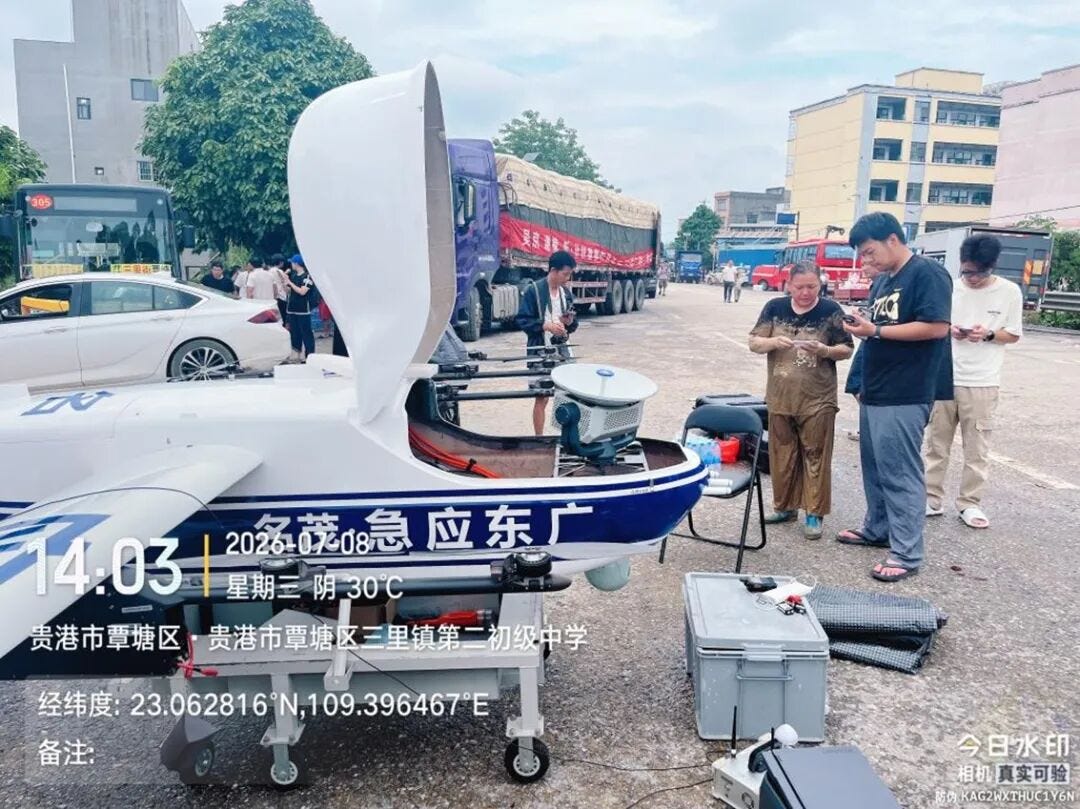
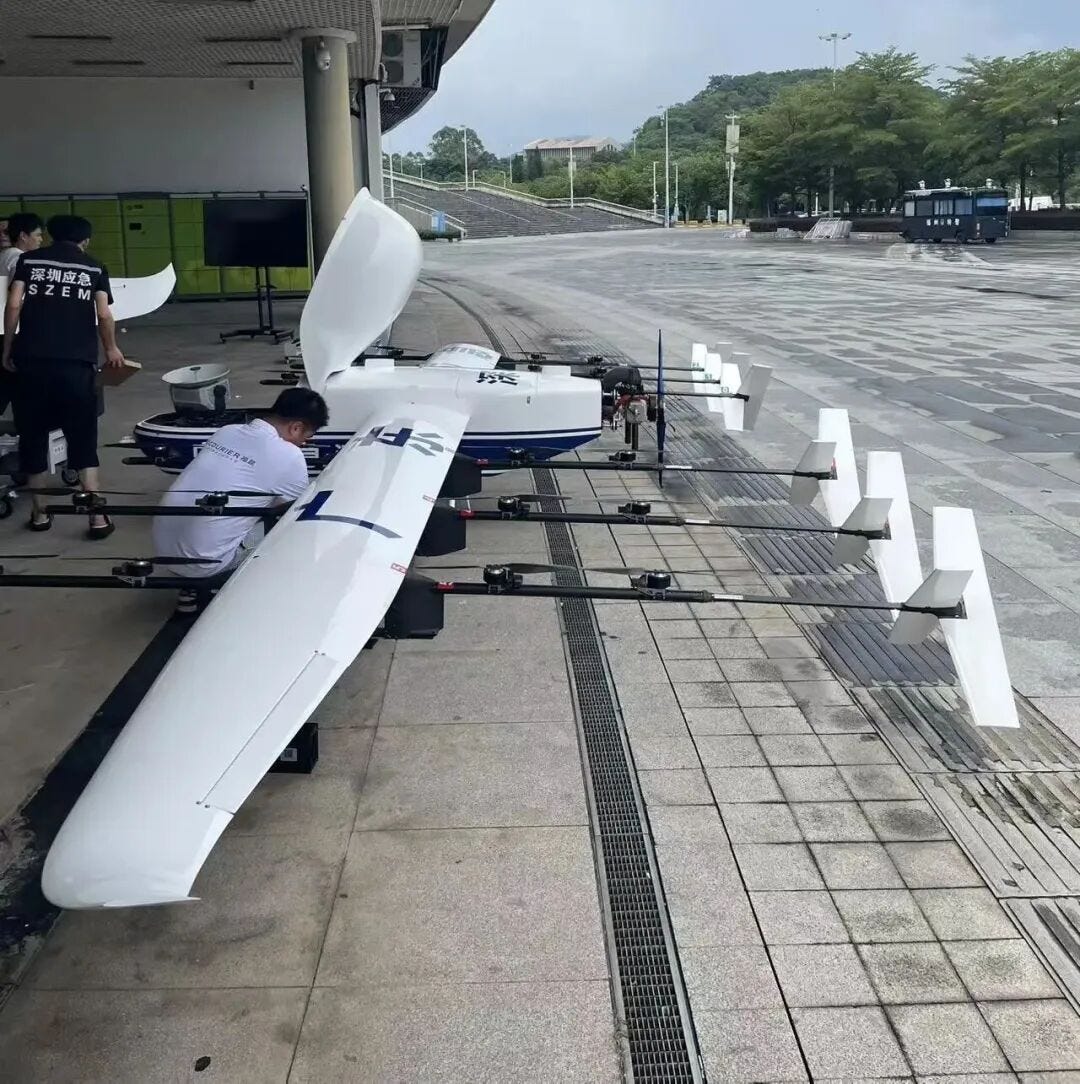
On July 8, following additional deployment orders, three more UAV teams from Yangjiang, Jiangmen, and Zhongshan were dispatched to reinforce operations across Guangxi.
Hard-Tech Innovation Restores Critical Communications
During the Guangxi mission, FCourier’s five E40H UAV teams operated around the clock.
As of July 12, they had completed:
10 flight missions
487 minutes of flight time
1,205 minutes of public mobile base station coverage
16,597 successful user connections
1,192 voice calls
These operations restored vital communications for disaster-affected communities and provided critical information support for emergency rescue efforts.
The E40H combines a hybrid-electric propulsion system with a VTOL fixed-wing configuration, integrating vertical takeoff and landing, efficient fixed-wing cruise, and long-endurance hybrid flight into a single platform.
Key specifications include:
Wingspan: 9.02 m
Length: 3.78 m
Height: 0.99 m
Maximum cruise speed: 115 km/h
Service ceiling: 4,500 m
Empty weight: 100 kg
Maximum payload: 50 kg
Maximum endurance: 10 hours
Maximum range: 850 km
Safe operation in Beaufort Force 8 winds and light rain
Most notably, the E40H holds a Type Certificate (TC) issued by the Civil Aviation Administration of China (CAAC), making it the world’s first medium-sized hybrid-electric VTOL UAV of its class to meet full airworthiness certification requirements.
Several media outlets described the Guangxi deployment as “the first time a fully airworthy industrial UAV has entered a national emergency rescue operation as an organized fleet.”
Simultaneous Operations in Guangxi and Fujian
While more than 20 FCourier personnel remained on the front line supporting flood relief in Guangxi, another emergency request arrived from Fujian.
Responding immediately, FCourier launched a second deployment involving more than 20 additional personnel from Guangzhou, Shenzhen, Heyuan, Shanwei, Zhongshan, and Shanghai, arriving in Fujian before Typhoon Bavi made landfall.
Upon arrival at designated standby locations, the teams immediately began mission preparation without delay.
Officials from the Fujian Aviation Emergency Rescue Center highly praised FCourier’s rapid response capability, standardized operational procedures, and the performance of the E40H platform.
Technology That Saves Lives
Equipped with an airborne public mobile base station, the E40H can provide mobile communications coverage within a 50-kilometer radius, rapidly restoring cellular connectivity in disaster areas.
The platform enables affected residents to contact family members, report emergencies, and send distress messages while simultaneously supporting emergency command through voice and video communications.
At the same time, the UAV conducts aerial reconnaissance, transmitting real-time imagery to emergency command centers to support damage assessment, resource allocation, and rescue planning.
This integrated capability effectively addresses three of the biggest challenges in disaster response:
Damaged transportation infrastructure
Communication outages
Difficulty assessing disaster conditions
The Guangxi mission once again demonstrated the operational value of emergency UAVs in restoring communications during the critical early stages of disaster response and provided a scalable, highly efficient solution for reconnecting isolated communities.
The deployment also attracted widespread media attention, with many online comments highlighting the impact of the technology:
“This is exactly the kind of UAV needed when roads, electricity, and communications are all cut off.”
“This is the true value of advanced technology.”
“Technology should be developed to reach places people simply cannot.”

A Proven Platform for Emergency Response
The E40H has become one of the primary aerial emergency response platforms supporting Guangdong’s emergency management system and has participated extensively in equipment maintenance, operational training, emergency exercises, and real-world disaster response.
The platform has repeatedly demonstrated its capabilities in major emergency missions.
September 2025 – Typhoon Wipha (Guangdong)
After Typhoon Wipha made landfall near Hailing Island in Yangjiang, causing widespread “three interruptions” conditions, the E40H supported disaster reconnaissance and emergency communications.
Mission results included:
8 flight missions
354 flight minutes
2,297 connected users
21.499 GB of mobile data traffic
9.91 hours of satellite-enabled communications
June 2025 – Historic Flooding in Huaiji, Guangdong
Under the unified command of Guangdong’s flood control headquarters, the E40H provided aerial reconnaissance and communications support, completing:
6 flight missions
325 flight minutes
4,189 connected users
102 minutes of voice communications
4.277 GB of mobile data traffic
Beyond emergency communications, the E40H has also completed nearly 10 major emergency response missions, including post-typhoon damage assessments following Typhoons Wipha and Podul, successfully flew a 150-kilometer cross-sea low-altitude logistics route between Yangjiang and Zhuhai, participated in nearly 30 emergency response exercises, and completed 3D mapping for more than 80 open-pit mines.
Drawing on these operational experiences, FCourier has established 20 standardized operating procedures covering aircraft maintenance, flight operations, emergency response, mission dispatch, and airspace coordination, creating a mature operational framework that continues to safeguard lives, property, and critical infrastructure.