

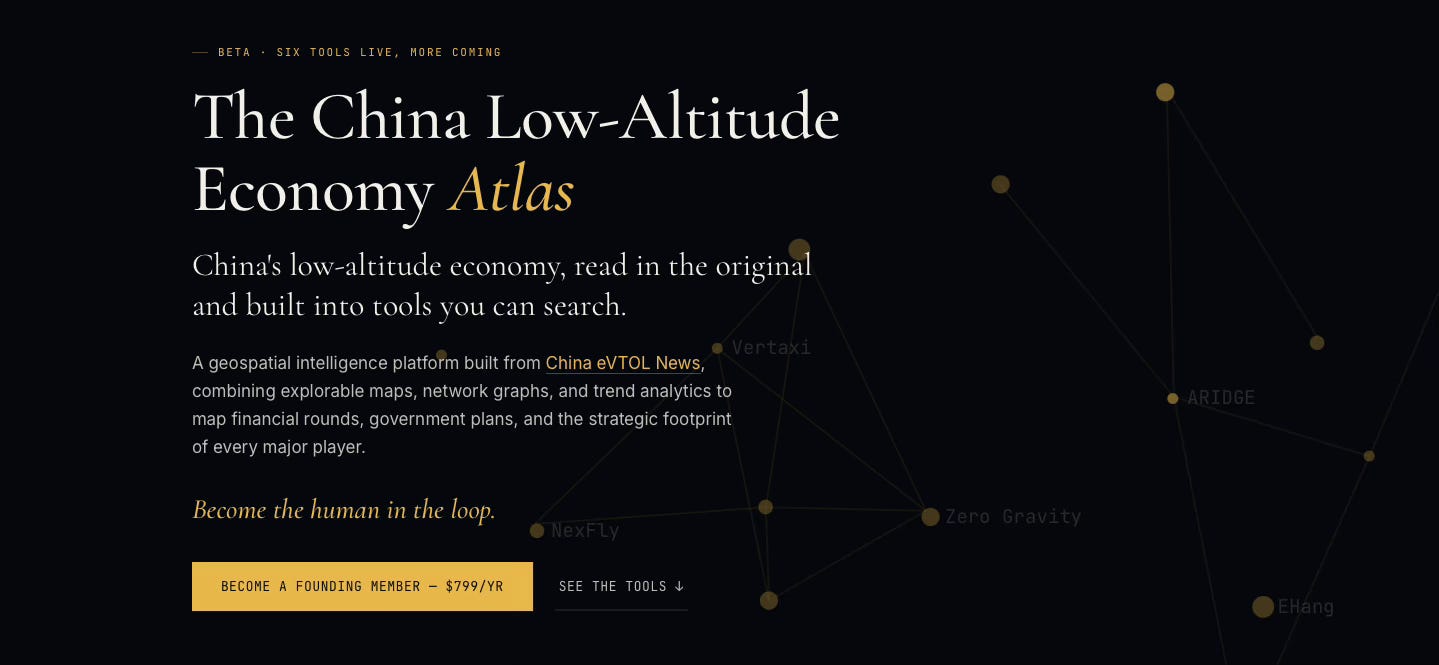
Introducing MyAtlas.Earth — six research tools built from the China eVTOL News archive. Two years of reporting, 1,100+ articles covering 2,000+ organizations, now searchable, cross-referenced and sourced.
Numbers and companies hidden for illustration purposes.
The Atlas consolidates the newsletter’s archive into a single repository. Query funding, investors, orders, international expansion, Belt and Road activity, or government policy across the full dataset.
Existing China eVTOL News subscribers: get in touch to join the beta trial in exchange for feedback. A limited number of spots are available while trialling is underway.
MyAtlas.Earth — $799/year. All six tools, updated weekly. Buy directly at myatlas.earth.
MyAtlas.Earth + newsletter — $999/year. Everything above, plus China eVTOL News. Buy directly at China eVTOL News (note: I have to manually add users to the MyAtlas.Earth).
Teams — MyAtlas.Earth starting at $3,500/year for five named seats, reassignable as staff change. Larger organizations quoted on request: hello@myatlas.earth.
These are founding beta rates, offered while the suite is built out. They apply to the term you purchase; pricing rises as the suite grows.
Let’s get into the tools.
MyAtlas.Earth
Funding Radar
Who raised what, and from whom.
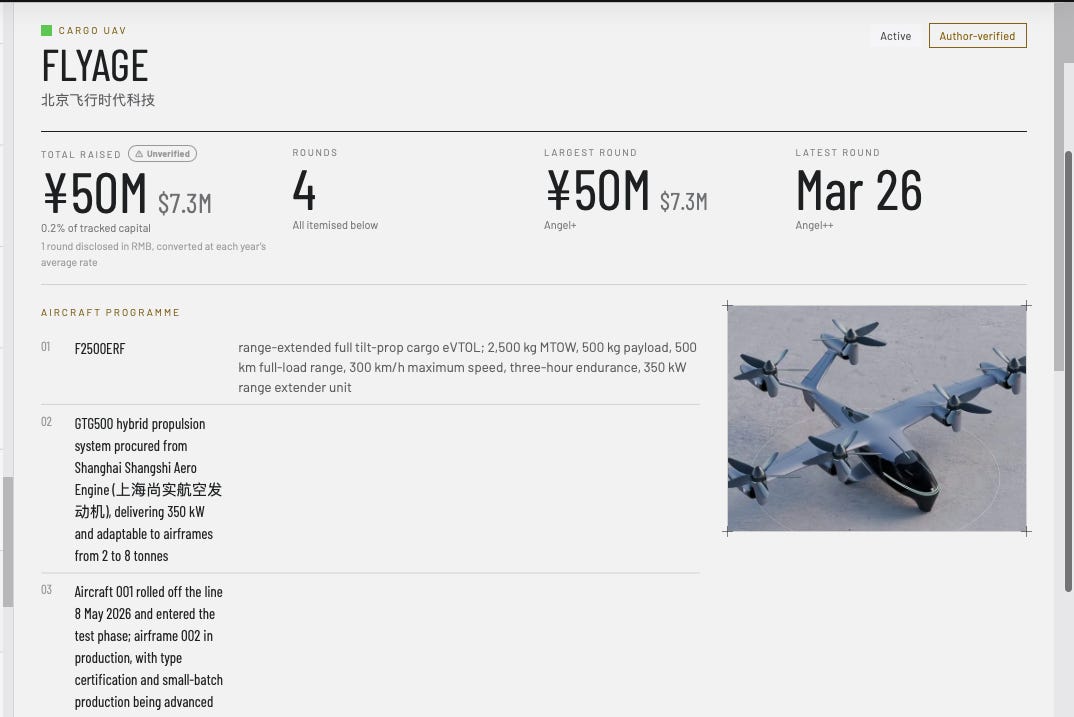
Tracks all funding rounds for 50+ Chinese eVTOL and low-altitude companies. Each entry carries its investors, use of proceeds, date and source article.
Sort by total raised, how often a company raises, or most recent round. Filter by segment — passenger, cargo, cargo UAV, airship, emergency, supplier — or by stage: listed, IPO track, revenue-generating, private.
Four views sit alongside the main list.
Cadence shows half-year round counts, so you can see whether the sector is heating up or cooling. Investor landscape surfaces every backer in your filtered results. What changed shows only the last four quarters. Compare puts up to four companies side by side.
Totals are computed, not asserted. Company totals derive from the round-level amounts shown beneath them — add up the rounds and you get the total. Rounds with no disclosed amount contribute nothing.
Rounds reported only in vague terms — “tens of millions”, “nearly a billion” — are not forced into precise numbers. They are excluded from the headline total and shown as a range, so exact figures and estimates stay distinguishable. Totals are floors, not complete accountings, and the tools say so.
Debt facilities are tracked separately and excluded from total raised — they are borrowing, not invested capital, and carry a DEBT tag wherever they appear. Corporate-control events, secondary share transfers and IPO filings are excluded for the same reason — no new capital enters the company.
A toggle lets you include them if you want the full transaction picture.
Exchange rates are per-year, not flat.
Chinese rounds are often disclosed only in RMB, and converting at today’s rate would misstate what a 2021 round was worth.
Each round converts at the annual average CNY/USD rate for the year it was announced — 6.452 for 2021, 6.730 for 2022, 7.075 for 2023, 7.189 for 2024, 7.129 for 2025, with earlier years covered back to 2014.
These are the IRS-published yearly averages, an official and citable source. 2026 stands at 6.8799 year to date, since the IRS publishes no average until a year closes; it will be revised then.
Every converted round shows the rate applied and is marked as an estimate. Rounds where the source published a dollar figure are used as stated and never re-converted.
Investor Radar
Who’s really backing whom.
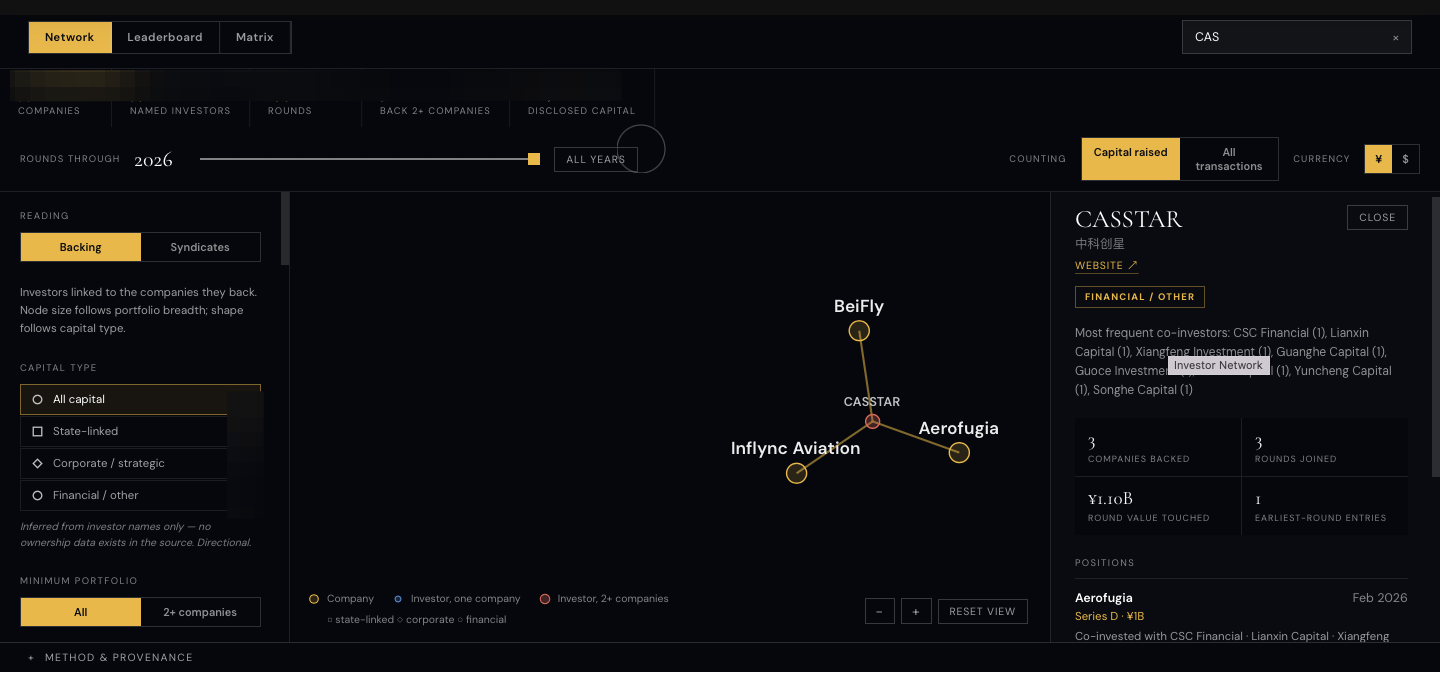
A live graph of investors and the syndicates that overlap. Search any investor to get their full portfolio, the stages they enter at, when they first appeared, and which other funds they keep showing up alongside.
A leaderboard ranks backers by portfolio and participation. A matrix view lays investor against company. Capital is classified as state-linked, corporate or strategic, or financial — inferred from investor names rather than ownership records, and labelled as directional rather than definitive.
A year scrubber replays the network as it stood at the end of any year, so you can watch syndicates form.
Investor names carry a specific discipline. A single firm can appear under several English renderings across different reports, and firms with similar transliterations are easily conflated, so every name is resolved against its Chinese original before it enters the graph.
Where two entries proved to be the same institution, they are merged. Where they are separately operated arms of one parent — a group’s early-stage vehicle against its principal fund — they stay distinct, because each makes its own investment decisions and combining them would overstate the parent’s reach. Brand families are recorded behind the scenes so those relationships remain recoverable.
The Funding Radar and Investor Radar are reconciled against each other. They read the same companies and the same rounds from opposite directions — one by company, one by backer — and agree company-for-company on capital raised.
Order Radar
Confirmed orders against letters of intent, judgment calls shown rather than hidden.
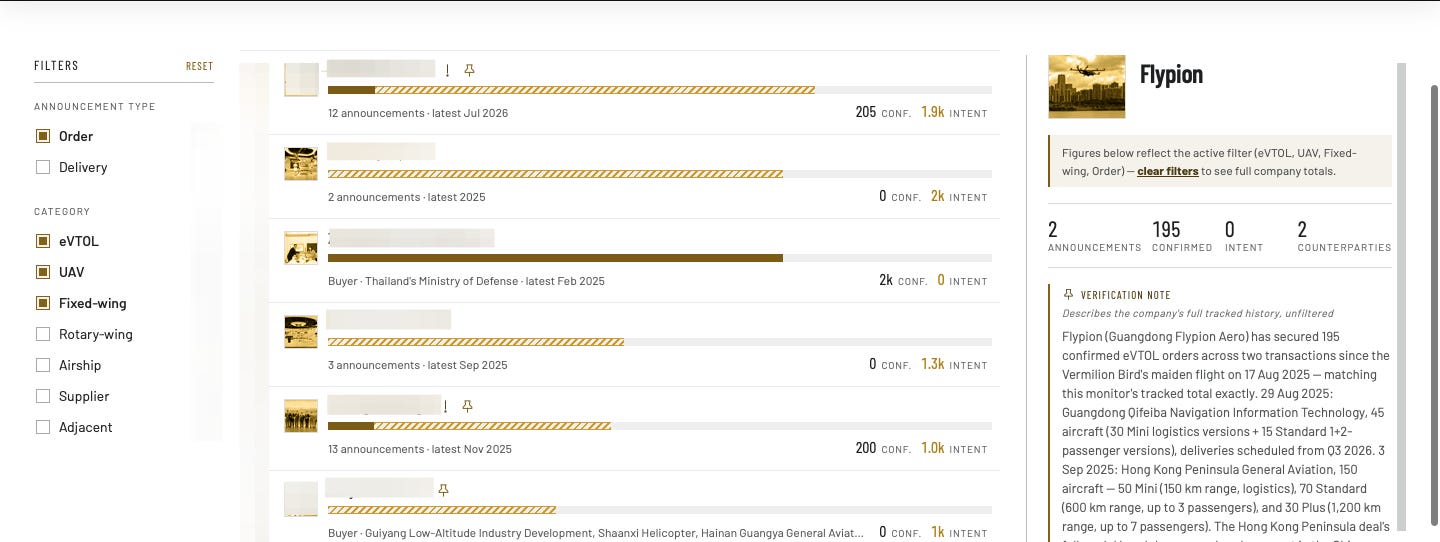
Every announcement is classified before it enters the ledger. Confirmed means a signed contract, purchase agreement or completed delivery. Intent means a letter of intent, MoU, pre-order, or an aggregate manufacturer claim with no named counterparty.
The two are counted separately and never summed into a single headline figure. Where a classification was arguable, the record carries the reasoning and a mark you can click through.
The ledger holds every announcement individually — company, buyer, location, date, category, type, direction, units, source — sortable on any column, opening newest first.
Filter to a specific month and year, to domestic or international, to a category, or to announcements.
Traditional large-aircraft manufacturers are tracked separately rather than mixed into the rankings, since they operate at a scale and in a market distinct from the low-altitude economy.
Geographic Radar
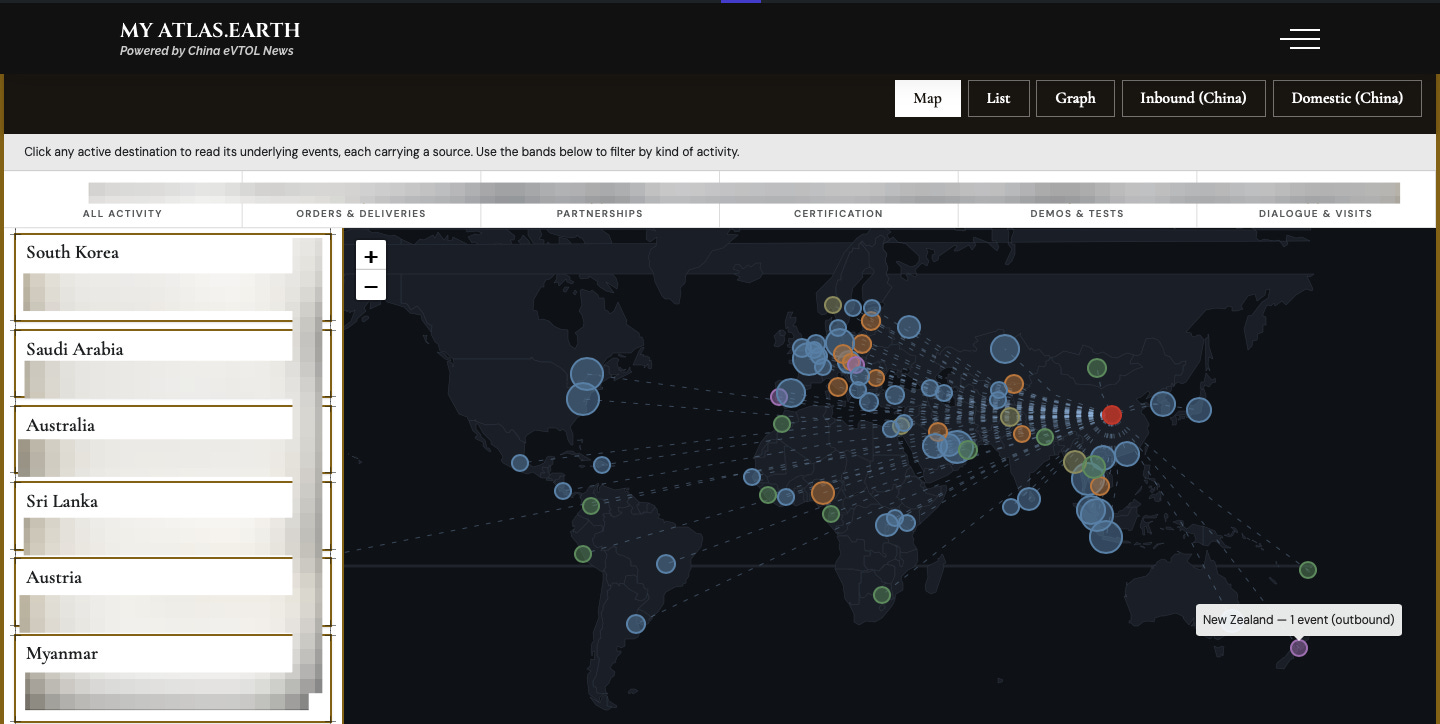
Where Chinese companies are landing.
Worldwide, including mainland China, and it distinguishes outbound from inbound activity — a Singaporean delegation touring a factory in Guangzhou is not a Chinese company landing in Singapore. The two are not mixed.
Activity is grouped into five kinds, each filterable: orders and deliveries, partnerships, certification, demonstrations and tests, and dialogue and visits.
Every event cites the archive article it came from. The same records are available as a map, a list and a relationship graph.
Belt and Road Radar
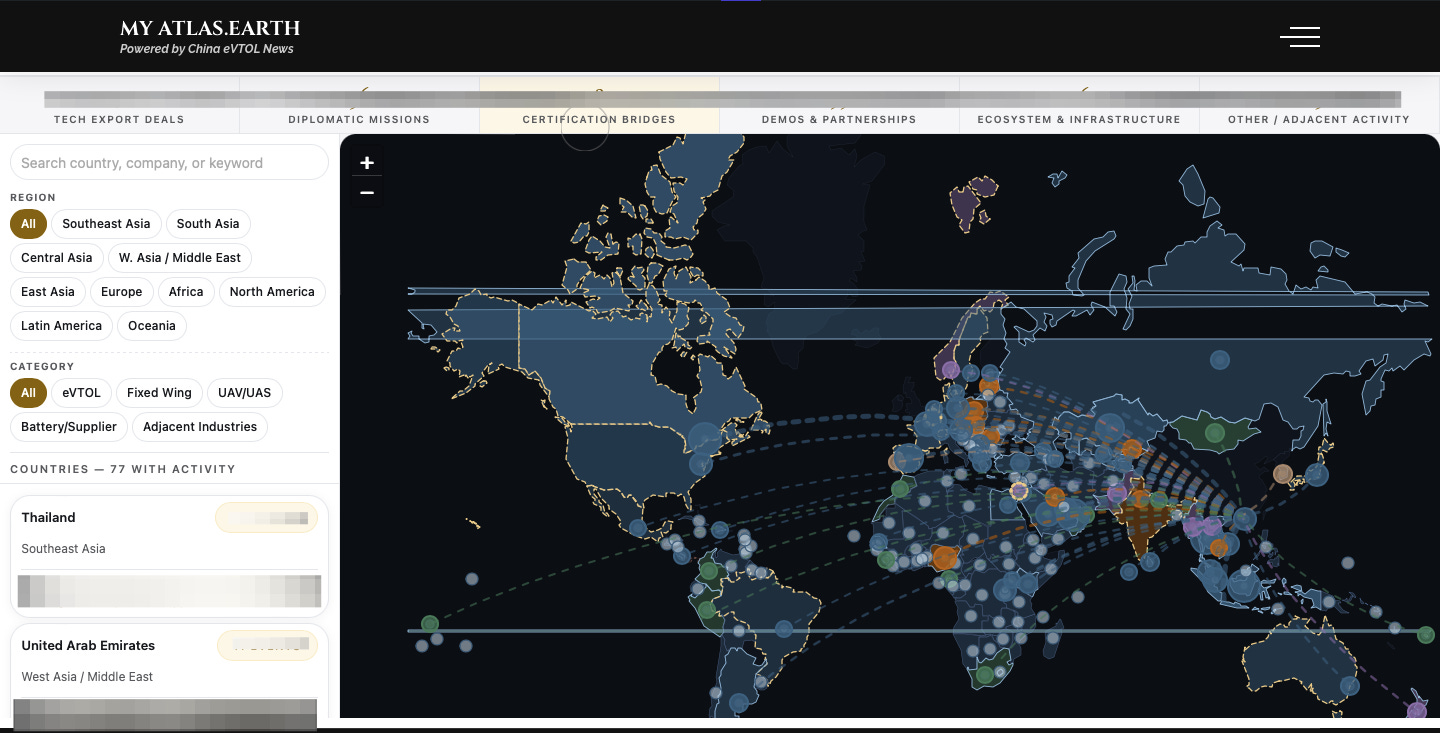
Global reach along the Belt and Road Initiative, country by country.
The same international activity, oriented around Belt and Road membership rather than geography alone.
The map shows three states. Countries that signed. Countries that signed and later withdrew — Italy and Panama — drawn dotted and labelled as such. And countries that never signed, drawn with a dashed outline, so they are never silently counted as Belt and Road partners.
Countries with close ties that never signed are marked differently again.
It shares countries with the Geographic Radar but answers a different question, so the two will not always show the same event count for the same country. Each applies its own scope deliberately.
Government Plans Radar
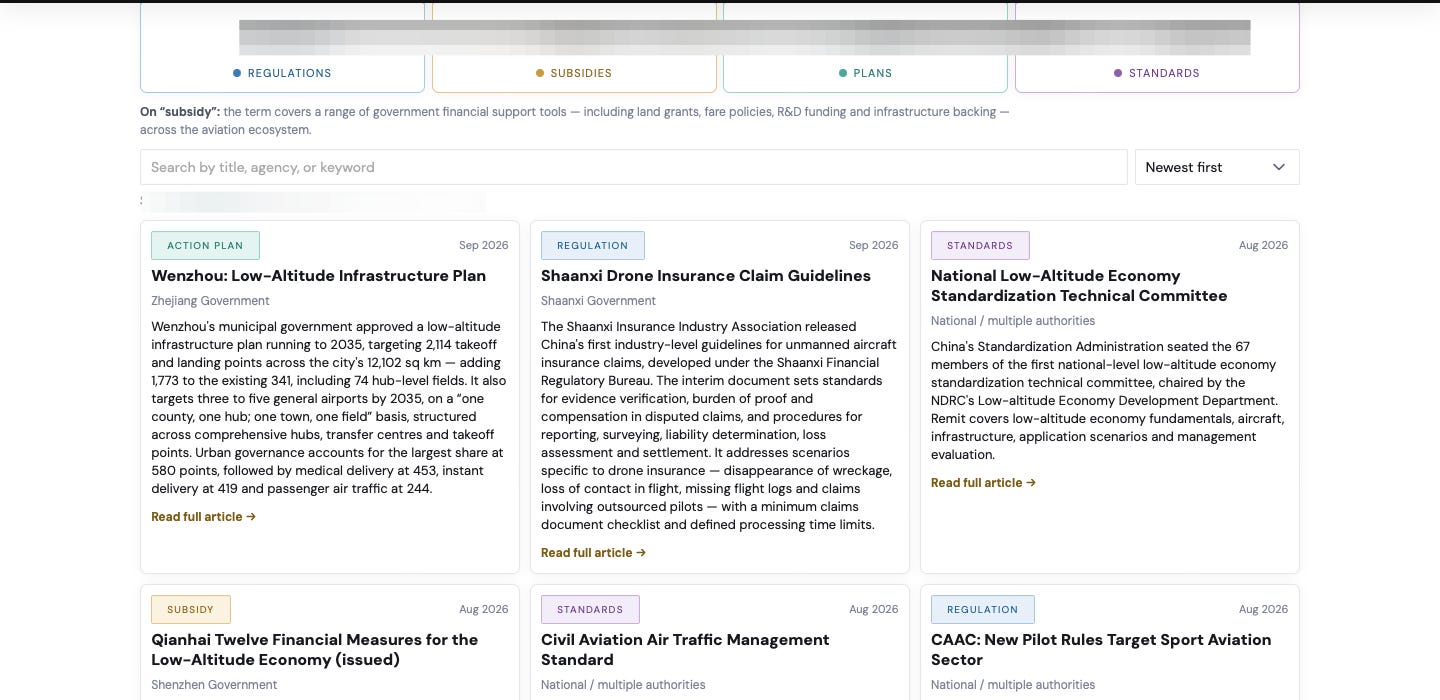
Provincial and municipal policy: subsidies, standards and the regulatory signals that move the market.
Policy is where the low-altitude economy is actually being built, and most of it never appears in English.
Each entry carries the issuing authority, the category — regulation, subsidy, action plan or standard — and a plain summary of what it requires, alongside the underlying document text in full rather than a summary and a dead link.
“Subsidy” is defined explicitly in the tool, because it covers land grants, fare policies, R&D funding and infrastructure backing rather than cash transfers alone, and the count means little without that.
Searchable by keyword, filterable by category and issuing body, and mapped by province, so you can see which provinces are legislating.
Superseded instruments stay in the record with their summaries intact but are excluded from the counts, so the current picture and the history are both available without one contaminating the other.
Verification
Every company, round and investor name is checked against the original China eVTOL article archive before it appears in a tool — by one person, me, the author. Where something is inferred rather than confirmed, it is flagged, with a confidence rating attached.
Nothing is presented as more certain than it actually is.
The tools show their provenance: what was disclosed, what was estimated, where sources conflict, and which reading I followed. Where a total is a floor rather than a complete accounting, I say so.
Headline figures are computed from the underlying records rather than typed in, so they cannot drift from the data beneath them.
This is journalism and analysis. It is not investment advice.
Working on next
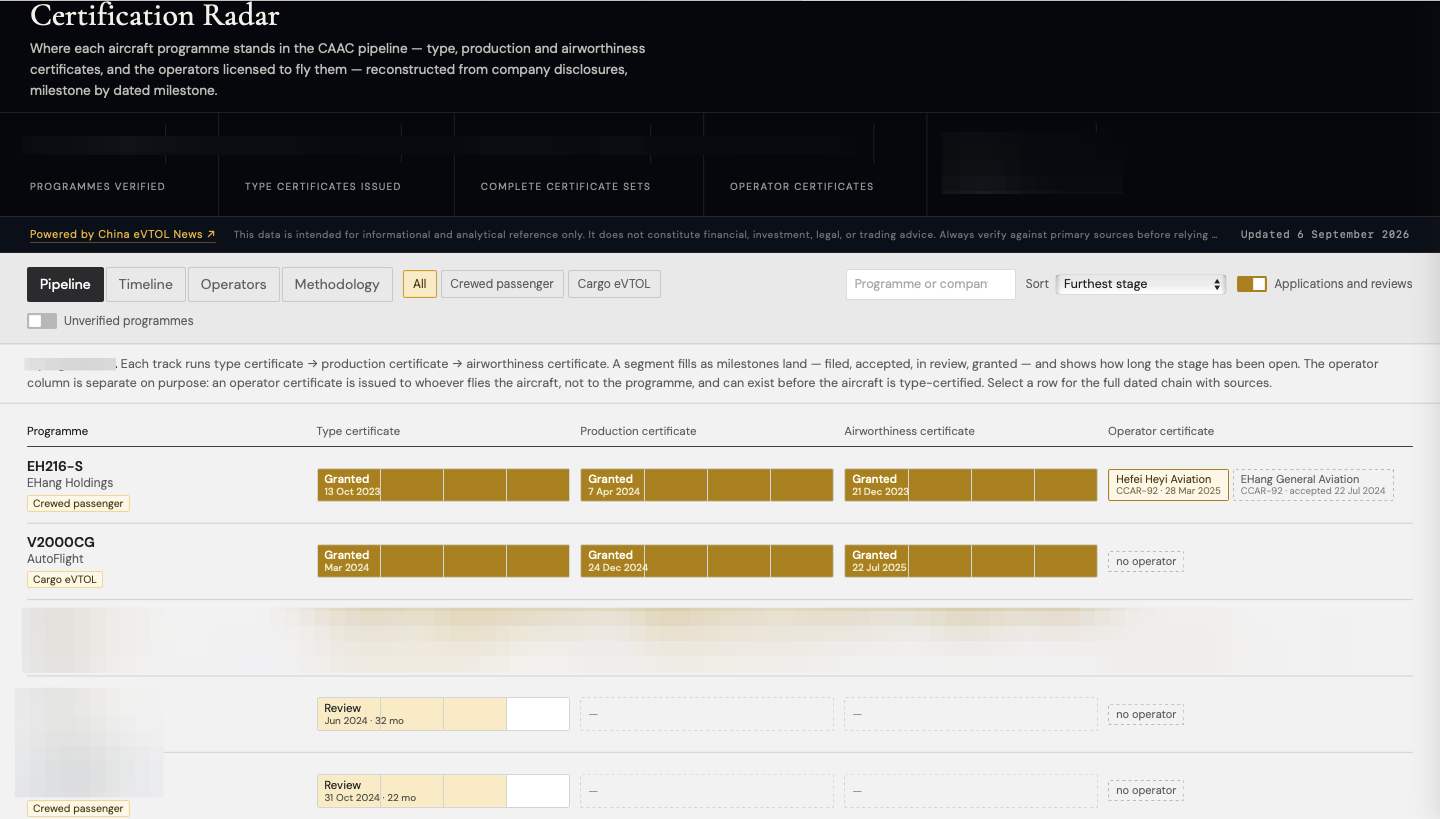
Certification Radar. The next tool tracks each aircraft programme through China’s certification pipeline — type certificate, production certificate, airworthiness certificate, operating certificate — with flight-test milestones as supporting evidence.
It answers the question the sector asks most and states least clearly: who can actually carry cargo/passengers commercially, and who is years away.
After that, infrastructure — vertiports, landing points and the provincial buildout that decides whether any of these aircraft carry anyone.
Coverage will also extend beyond China.
On terms of use
Thank you for respecting the terms.
This is a subscriber product built from two years of original reporting, verified record by record. It represents a substantial amount of work by one person — me, the author — and the terms exist so that work can continue.
Please don’t share access credentials or republish the underlying data. Limited internal use is covered by your licence. Please read the terms.
Journalists and researchers — you can cite a handful of figures with attribution without asking. Visual output and rankings need permission. Thank you asking.
If you want to use the data more extensively or need something in a form the tools don’t provide, please reach out. The answer is usually yes.
Full terms at myatlas.earth. Enquiries: hello@myatlas.earth.
The tools are updated weekly. As the archive grows, so does the Atlas. More tools to come.
Stay curious, keep watching the skies — and thank you for supporting independent news.
—Jennifer