Investor Opportunity: PIAviation Seeks Backers
The Shanghai startup is looking to scale China's GA data network.

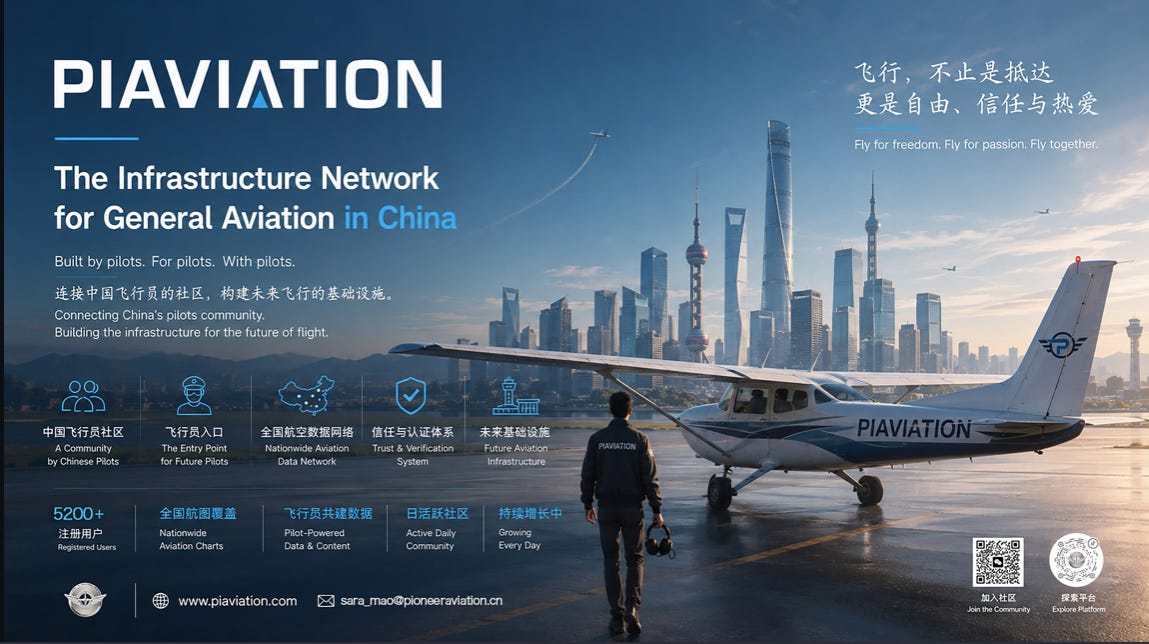
Sara Mao, founder of Shanghai-based PIAviation, recently reached out to share the company’s pitch deck.
The startup is now looking for investors, both inside and outside China, to support its efforts to build a digital infrastructure layer for the country’s general aviation sector.
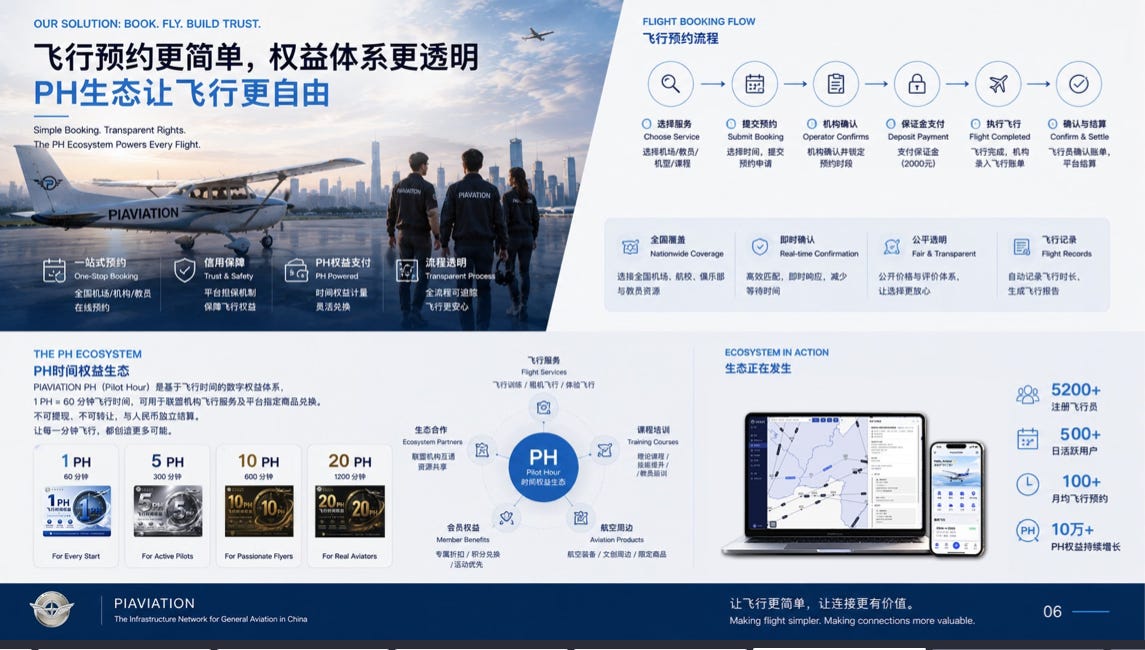
The pitch deck outlines a platform that combines pilot community, aviation data, flight booking, and a digital rights system called PH (Pilot Hour).
The pitch deck can be accessed here.
It is also re-produced after the explainer.
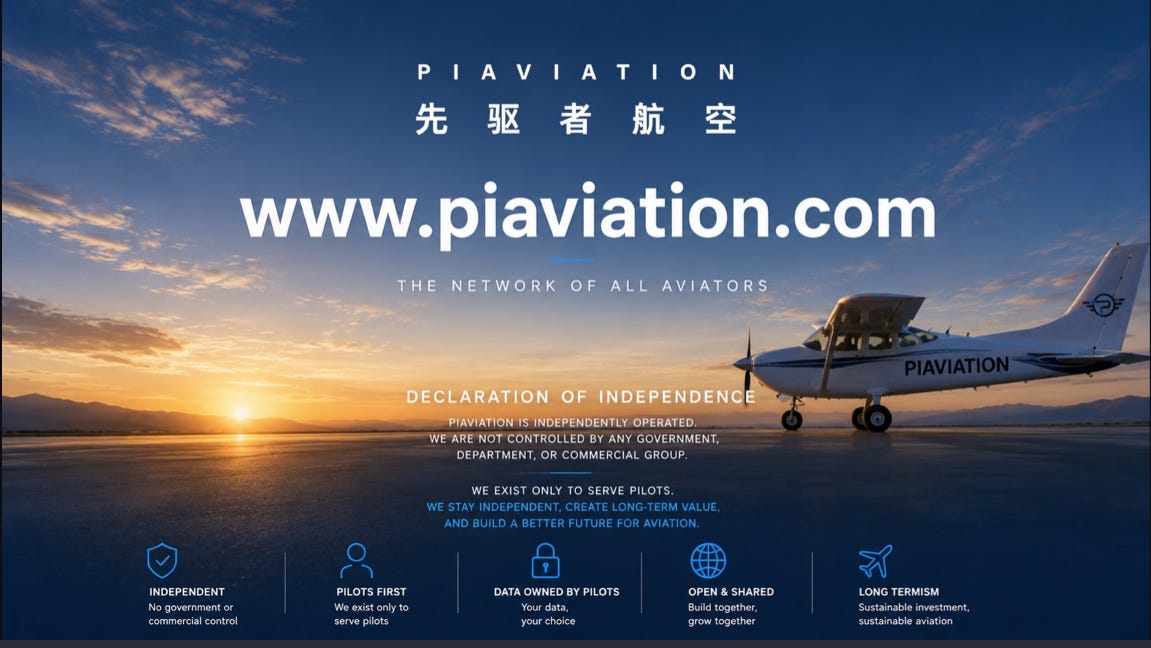
PIAviation's website is www.piaviation.com. The company can be reached via email at sara_mao@pioneeraviation.cn.
I previously interviewed Mao for Aviation Week. See China’s GA Growth Stalled By Data Fragmentation, Startup Cautions, for additional background.
Pitch Explainer

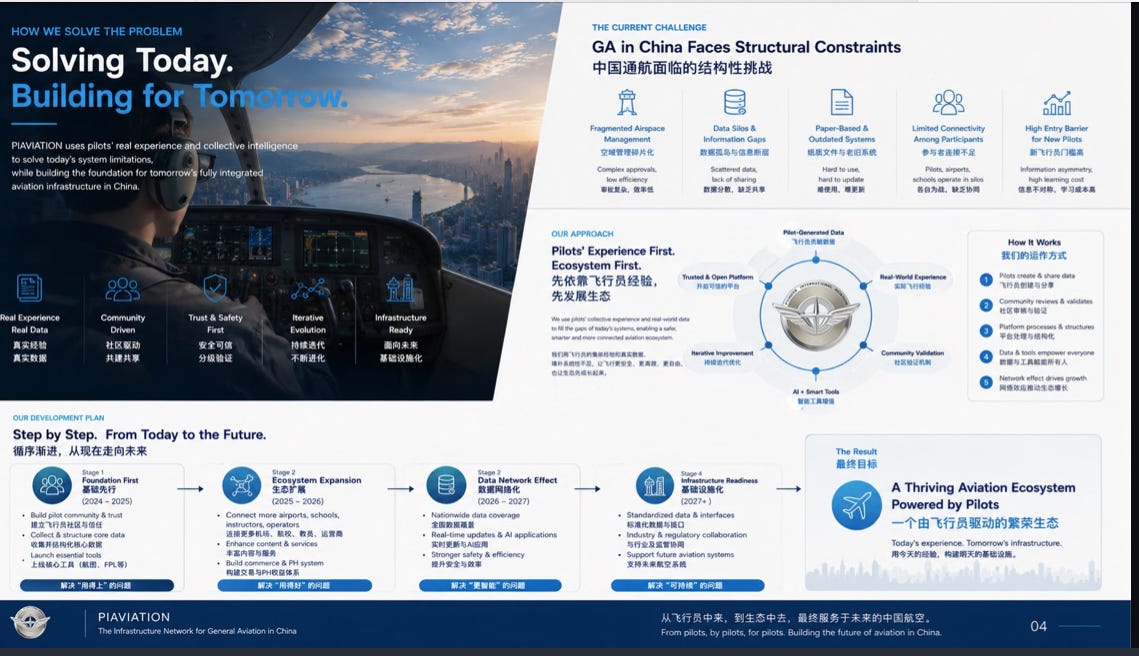
The Problem: Fragmented Data and Workflows
According to the company’s materials, China’s general aviation sector faces structural constraints that limit scalability. These include fragmented airspace management, data silos, paper-based systems, limited connectivity among participants, and high entry barriers for new pilots.
Mao previously described the issue in more detail — training records, operational workflows, and pilot data remain siloed within individual organizations. Trust between institutions often depends on personal relationships rather than verifiable systems.
The company argues that these frictions affect the entire flight lifecycle and could become a bottleneck as advanced air mobility (AAM) and eVTOL aircraft enter the market.
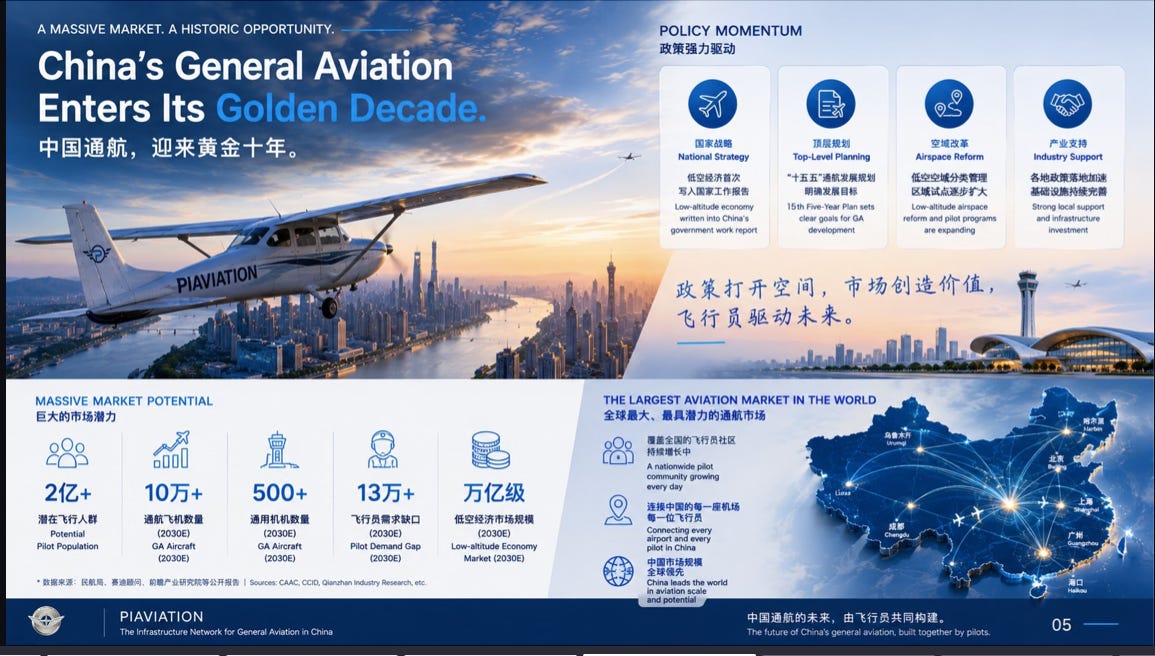
The pitch deck notes that while policy momentum is strong—with the low-altitude economy written into government work reports and the 15th Five-Year Plan setting clear GA goals—the operational infrastructure to support growth is still missing.
The Platform: Data, Community, and a Digital Rights System
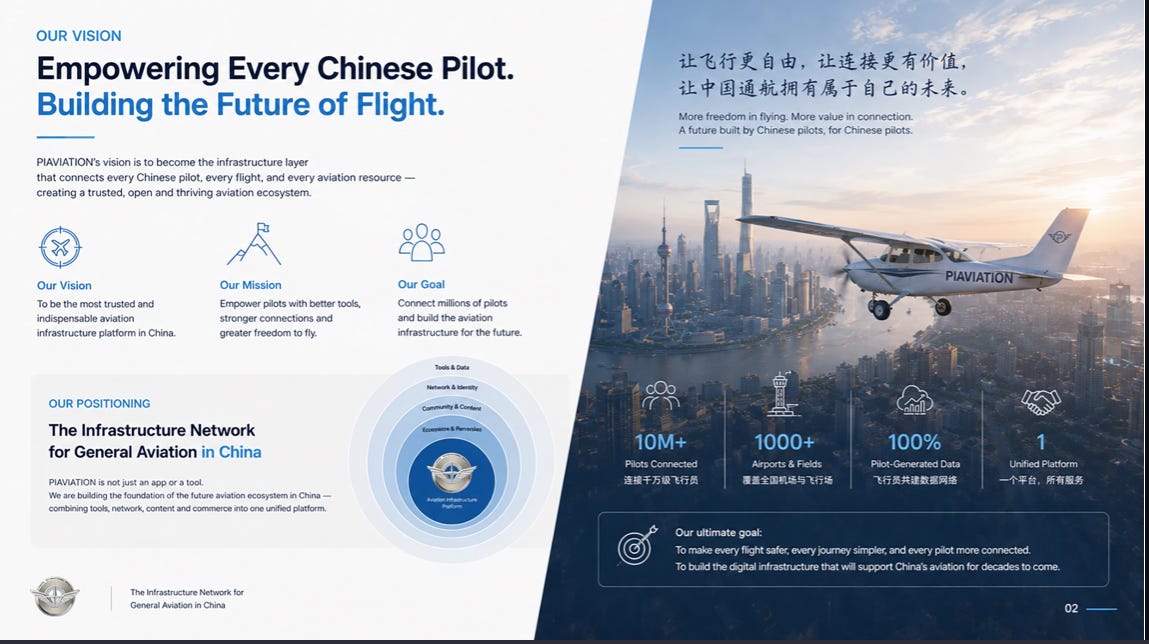
PIAviation is positioning itself not as an app or marketplace, but as a foundational network that connects pilots, airports, schools, and operational workflows.
It has built a platform that includes several components —
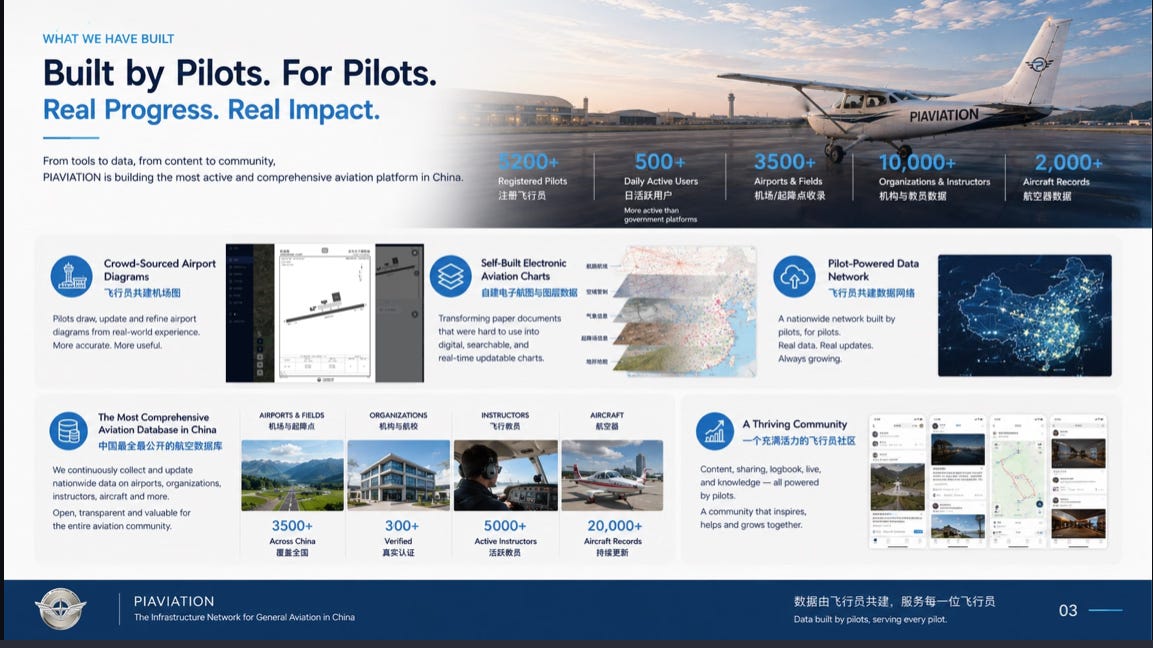
A nationwide aviation database covering airports, organizations, instructors, aircraft, and other data points. The company says it has mapped data for every GA airport and institution in China.
Crowd-sourced airport diagrams, contributed and updated by pilots based on real-world experience.
Flight planning, performance calculation, flight tracking, and pilot behavior modules, which are now coming online.
A pre-authorized payment system with UnionPay, currently in development.
The company also introduced a digital rights system called PH (Pilot Hour), where 1 PH equals 60 minutes of flight time. PH can be used for flight bookings, services, and platform products. It is non-transferable and settled in RMB.
According to the pitch deck, the system does not depend on complete infrastructure coverage.
With limited ADS-B adoption across China’s GA fleet, PIAviation builds around user behavior: pilots log GPS tracks, use a record/stop button, and photograph Hobbs meters.
These data points link with flight plans and post-flight records to form a continuous chain. As infrastructure improves, the company says, additional data streams can be integrated without rebuilding the system.
Traction and Metrics
The pitch deck reports the following metrics:
5,200+ registered users
500+ daily active users
100+ monthly flight bookings
100,000+ PH time rights issued
Market Context
The company’s materials cite government policy as a key tailwind. The low-altitude economy has been included in national work reports, airspace reform is expanding, and local governments are investing in infrastructure.
The deck projects a potential flying population of over 2 billion, 100,000+ GA aircraft by 2030, a pilot demand gap of 130,000+ by 2030, and a trillion-yuan low-altitude economy market.
What PIAviation Is Seeking
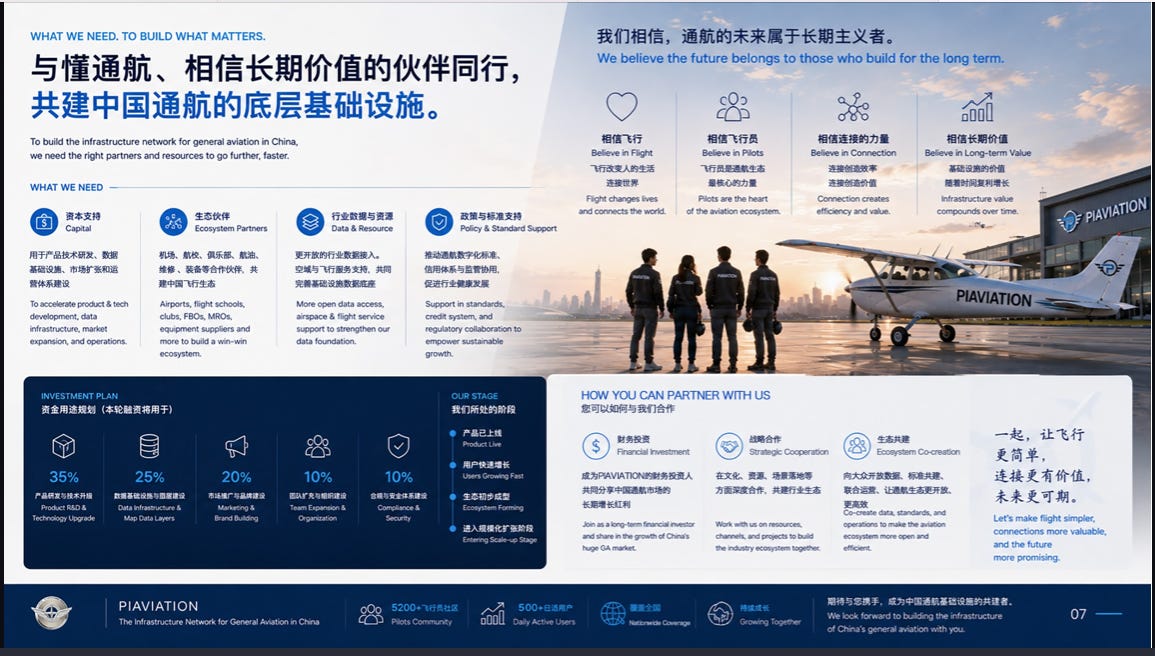
The company is looking for —
Capital to accelerate product development and market expansion.
Ecosystem partners, including airports, flight schools, clubs, FBOs, MROs, and equipment suppliers.
Data and resource support, such as more open data access and airspace rights.
Policy and standard support to help with regulatory collaboration and industry standards.
The pitch deck outlines a use of funds — 35% for product R&D and tech services, 25% for data infrastructure and operations, 20% for market expansion and brand building, and the remainder for brand and marketing activities.
The company states it is independently operated and not controlled by any government, department, or commercial group. It emphasizes that pilots control their own records and that the platform does not own user data.
Author’s note — This article is for informational purposes only and does not constitute financial, legal, or investment advice. The author does not endorse or recommend any specific investment opportunity. Readers should conduct their own due diligence and consult with a qualified financial advisor before making any investment decisions.
Pitch Deck — PIAviation