
Uncrewed Aircraft Aid Shenzhou-20 Recovery
First, a cautionary tale. Be careful who you talk to and write for.

First, A Cautionary Tale
Last May, I was approached by Jeremy Goldkorn editorial fellow at ChinaFile, a website of the Asia Society, which he described as a non-profit established in New York in 1956 to “navigate shared futures for Asia and the world across policy, arts and culture, education, sustainability, business, and technology.”
He invited me to join one of their “ChinaFile Conversations” — a series where so-called “experts” respond to questions about current events in China. The prompt for this edition was: What will be the next Sputnik moment in China?
I wrote about China’s space ambitions — with a small section on eVTOL aircraft OEM overlap + hype, but the heart of the opinion piece was space.
(Key words: opinion piece)
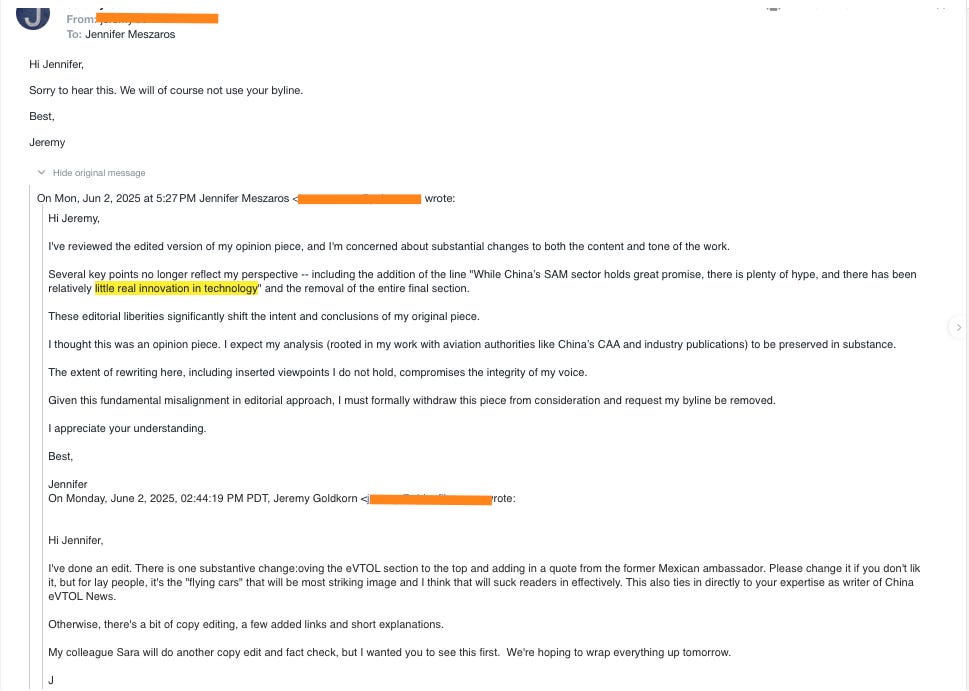
Unfortunately, what followed was a complete rewrite of my initial opinion — despite Goldkorn telling me in May that my piece was “fien (sic) to leave as is if you are happy with it,” the edits were brutal — not my words, but his, using my name.
Goldkorn was determined to produce a story on eVTOL aircraft and set out to completely change my opinion… on my opinion piece.
(What Canadians would call a “douche canoe” move — well, this Canadian, anyways)
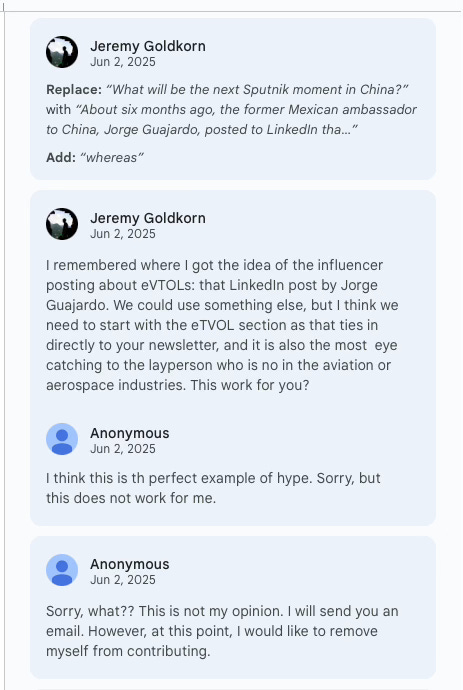
Beyond major re-writes, Goldkorn suggested that I steal adopt, as my own, a thought from former ambassador Jorge Guajardo, who had written on LinkedIn: “This will be the next Sputnik moment, and it’ll come through Instagram as visitors post about flying cars and package delivery in China. Keep an eye on this one.”
And much to my irritation, Goldkorn wanted me to use the term “flying cars,” arguing it would create a striking image to hook readers — no matter how absurd it was in the context of my piece.
“My own instinct and part of the reason I reached out to you is that I think one coming Sputnik moment will be when an American influencer arrives in, say, Shenzhen airport, and instead of taking a taxi, takes an uncrewed eVTOL to their hotel, and films the whole thing for Instagram or TikTok. Even if the tech itself is not particularly new or amazing. Don't you think that is a possibility? And if so, maybe you could say something about it at the top, and then point out that there may also be a lot of hype in the sector? — Goldkorn (May 30, 2025).
An influencer’s eVTOL ride, while it may go viral (maybe), doesn’t threaten U.S. military/economic primacy. A Chinese nuclear-powered Mars rocket, however, would prove they lead in propulsion, deep-space AI, resource extraction, etc….For me, I would never frame China’s rise through the lens of American influencer content. If I did, I would be destroyed by my peers and rightfully so — Me (May 31, 2025).
Over the course of more than 20 email exchanges, I repeatedly explained why eVTOL aircraft were not the next Sputnik moment and raised concerns about the heavy-handed edits. After declining his suggested rewrites three times, I ultimately withdrew from contributing.
Seven people participated in the Sputnik Moment article — I can’t help but wonder if Goldkorn took extreme liberties with their pieces as well.
However, I did talk with a (male) writer who had a similar heavy-handed editorial experience with Goldkorn in the past.
I also reached out to his (female) senior editor, who apologized on Goldkorn’s behalf, saying it was a mistake and that it would never happen again.
Goldkorn never reached out to apologize — not surprising but ironic, considering he recently shared a quote about female voices — or lack thereof — in China analysis.
That said, this is not a “gender” issue; it is an “everybody” issue.
With the media world being what it is — the constant challenges of finding homes for (APAC) stories, the spread of disinformation, and the pressure to grab readers’ attention — it is more important than ever for writers to have editorial spaces that respect accuracy, integrity, and individual voice — especially in an opinion piece.
(And here is a copy of that bastardized piece Goldkorn wrote, living in Google Docs — stripped of my voice. And what’s up with the bullets?)
I also argue that it is equally important for companies being interviewed or cited by the media to have their perspectives represented accurately — no one wants, or deserves, a rogue reporter or editor.
The lesson? Be careful who you talk to and write for.
An American friend of mine said, “Stay away from think tanks.” While I don’t think that’s entirely fair, the key is to be selective and cautious about whom you trust with your work.
(Also, be careful where you source your information. Avi-Go, a self described "intelligence and data solutions" provider headquartered in Singapore, plagiarized one of my business aviation articles in its entirety and took full credit.
See my original article in Aviation International News: Southeast Asia’s Business Aviation Sector on the Rise)
But this isn’t just me sharing a shit editorial experience — it’s actually a segue into space news.
(But thank you for attending my “TED Talk”)
Let’s get into it.