
MA700 Re-Engine Ends Canadian Blockade
Potentially.

The Modern Ark 700 (MA700), China's 70-seat turboprop regional airliner, re-engined with the domestically produced AEP400, successfully completed its test flight on June 5 at Xi'an Yanliang Airport in Shaanxi province.
The flight, reported by multiple local news outlets citing CCTV News, is being hailed as the end of a six-year engine supply blockade imposed by Canada and a major breakthrough in China's quest for self-reliance in aviation propulsion.
While I have been awaiting further developments since the story first broke, the successful re-engining of the MA700 with a domestic powerplant warrants a write-up on the program's journey from inception to its long-delayed return to the skies.
Project Background and the Supply Cutoff
The MA700 is a key component of China’s “two trunk and two regional” civil aviation development strategy, alongside the CR929, C919, and the C909 (formerly ARJ21).
The program was launched by Xi’an Aircraft Industrial Corporation (XAC) in 2006, building on experience from the MA60 and MA600, with the goal of competing in the global 70-seat turboprop regional airliner market.
The project received internal approval from the Aviation Industry Corporation of China (AVIC) in 2008 and formal approval from China’s State Council on December 19, 2013.
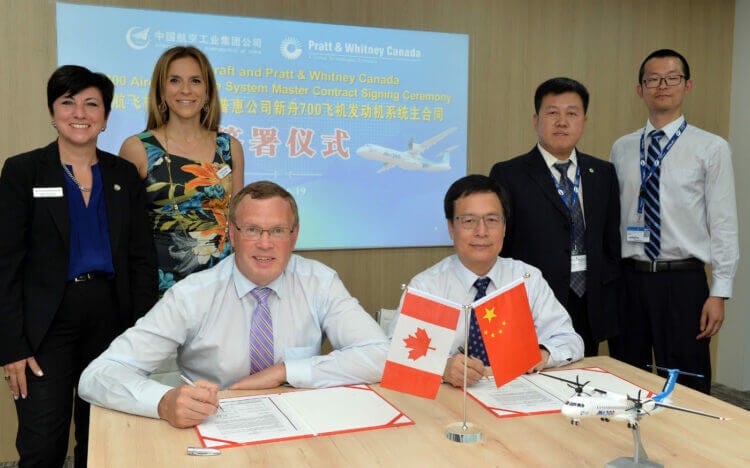
Originally, the MA700 was designed to use the PW150C engine from Pratt & Whitney Canada.
In 2017, XAC inked a $3 billion contract with the Canadian manufacturer.
An initial test flight with the PW150C was slated for late 2019, but there is no public record of it having occurred.
The certification program was disrupted in 2020 when Canada cited national security and blocked engine exports.
In 2021, Ottawa formally halted all PW150C deliveries, which ground the MA700's test program to a halt and froze the assembly line.
"The PW150C turboprop engine continues to build on the proven PW150A engine architecture and will incorporate the latest technologies to deliver performance and fuel efficiency to the newly designed MA700 aircraft. Enhancements we have built into the PW150C engine include advanced high-efficiency technologies, materials and manufacturing processes, including a third-stage power turbine, a modified reduction gearbox to support the aircraft's larger-diameter propellers and an optimized low-pressure compressor" — Frédéric Lefebvre, Vice President, Marketing, P&WC (June 19, 2017).
« En bloquant la transaction, soit Ottawa craint un vol de propriété intellectuelle, soit il redoute l’usage de ces moteurs à des fins militaires », nous a-t-on dit — Le Journal de Québec / TVA Nouvelles, “Contrat de 3 G$ bloqué pour risques d’espionnage,“ September 9, 2020.
(English translation: “Either Ottawa fears intellectual property theft, or it fears these engines being used for military purposes,” we were told, regarding the blocking of the deal.
One could argue that the project had no choice but to advance development of the domestic AEP400 engine, which was still in the research phase at the time.
While Canadian authorities formally cited 'national security review' for the engine blockade, several Chinese media outlets and analysts widely attributed the move to Pratt & Whitney's 2020 merger with US defense giant Raytheon. The merger subjected the PW150C to US International Traffic in Arms Regulations (ITAR). Combined with the US government's addition of Xi'an Aircraft to the 'Military End-User' list that same year, Canada's export denial was viewed as a US-led sanction.
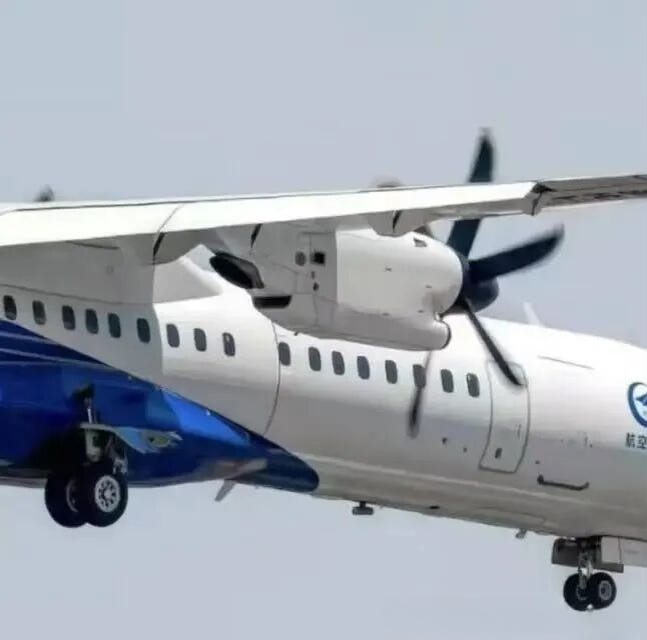
The AEP400 Powerplant
According to Chinese media reports citing industry sources, the AEP400 is a fourth-generation turboprop engine developed by the AECC Hunan Powerplant Research Institute.
Its reported development timeline is as follows:
2018: Pre-research began
2020: Core engine test was successful
2022: Installed for engine testing
2024: Completed test flights on a Y-8 platform
2025: Officially finalized and entered mass production
June 5, 2026: Successful re-engine test flight on the MA700
April 2021 footage uploaded to Chinese social video site Bilibili — and later reported by The Air Current — shows the Xian MA700 undergoing simulated driving rain tests on a ground stand. The aircraft's PW150C engines are absent; their delivery blocked after Canada denied an export license. The video marked the first public sighting of the MA700 since the static test airframe was rolled out in March 2020.
Reported Key Technical Specifications:
The AEP400 delivers a maximum output power of 4,000 to 4,200 kilowatts (approximately 5,364 to 5,632 shaft horsepower).
To put this in historical context, this represents approximately a 10 percent increase over the older Turboprop-6C (WJ-6C). The WJ-6C, a Chinese derivative of the 1950s-era Soviet AI-20M turboprop, had long served as the default domestic powerplant for China's Y-8, Y-9, and earlier MA-series aircraft. However, its outdated single-shaft design, high fuel consumption, and heavy weight made it unsuitable for a modern civil airliner.
The MA700 was not designed to use the WJ-6C operationally; it was considered as a temporary fallback when the originally planned foreign engine became unavailable.
Cruise fuel consumption is reported at or below 0.225 kilograms per kilowatt-hour.
This represents a 31.6 percent reduction compared to the Turboprop-6C. Chinese media have additionally claimed this is at least 13.5 percent lower than the Pratt & Whitney Canada PW150C.
However, this specific figure is unverified — Pratt & Whitney Canada does not publicly release a verifiable SFC figure for the PW150C, and the 0.26–0.27 kg/(kW·h) baseline used to calculate the 13.5% reduction appears only in Chinese media without attribution to an OEM source.
The PW150C produces approximately 4,600 kW, meaning the AEP400 has slightly lower absolute power output. However, the AEP400’s fuel efficiency is reportedly better.
According to published figures, the Rolls-Royce AE2100 engine, which powers the Lockheed Martin C-130J, has a fuel consumption of 0.249 kg/(kW·h), placing the AEP400’s reported figures within a competitive range.
The engine’s dry weight is approximately 900 kilograms (about 1,984 pounds). This is nearly 300 kilograms (about 661 pounds) lighter per engine than the Turboprop-6C, which weighs between 1,080 and 1,200 kilograms (2,381 to 2,646 pounds).
The AEP400 features a three-shaft (tri-spool) design. Compared to two-shaft and single-shaft turboprop engines, this design allows the compressor and turbine to operate more independently, which can improve efficiency and reliability.
According to reports, the engine provides 40 percent more thrust at 3,000-meter (approximately 9,843-foot) altitude airports compared to the Turboprop-6C.
The propeller uses six high-skew composite material blades, replacing the four-blade metal design found on both the WJ-6C and the PW150C.
The composite blades, made from carbon fiber, feature a swept-back angle intended to reduce airflow separation and lower noise.
Author’s Note: The specifications and timeline presented above are based on information derived from Chinese media reports and have not been independently verified by the manufacturer.
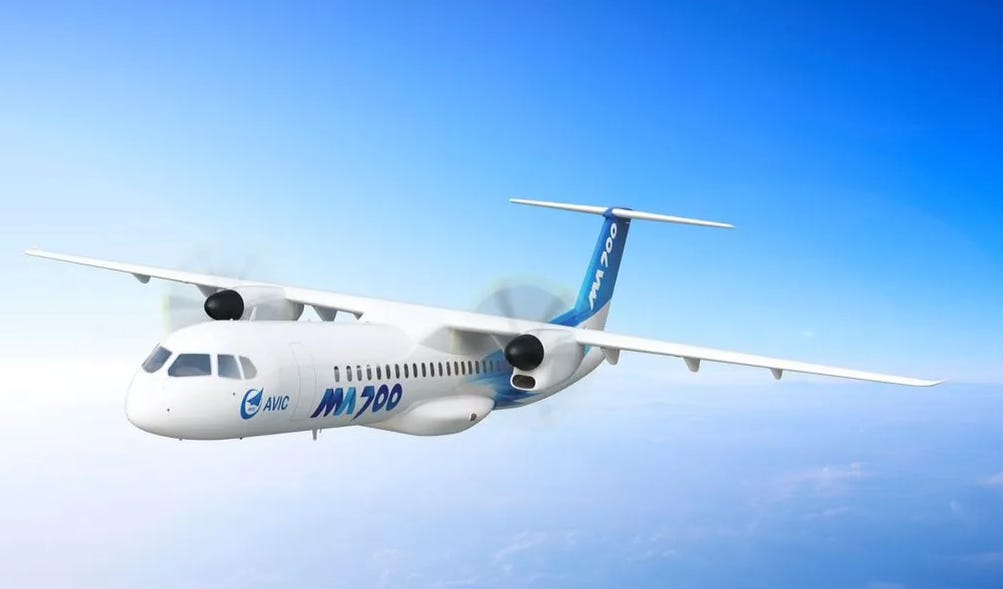
MA700 Aircraft Specifications
Based on local reports, the MA700 has an overall length of 30.9 meters (approximately 101.4 feet) and a base seating capacity of 70 passengers.
It is primarily designed for regional routes of up to 800 kilometers (approximately 497 miles) and has a maximum range of 2,700 kilometers (approximately 1,678 miles).
The aircraft has a maximum cruise speed of 637 kilometers per hour (approximately 396 miles per hour) and a reported service ceiling of 7,620 meters (approximately 25,000 feet).
Market entry is targeted for 2027.
Author’s Note: The MA700 specifications listed above are based on publicly available sources and may not reflect final production configurations.
Beyond the MA700
The AEP400’s impact extends beyond the MA700.
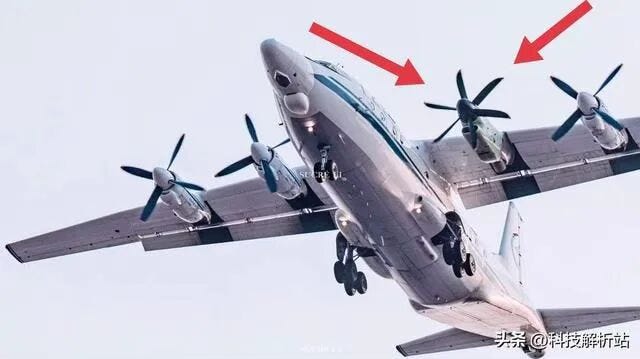
According to local media reports, when the Y-9 transport aircraft was re-engined with the AEP400, its range increased from 5,000 kilometers (approximately 3,107 miles) to 7,300 kilometers (approximately 4,536 miles) – a 46 percent improvement.
The KQ-200 anti-submarine patrol aircraft has also reportedly begun transitioning to the AEP400.
Moreover, some reports note that the AEP400’s core technology can potentially be derived into a 4,000 to 5,000 kilowatt-class turboshaft engine for helicopters, which could shorten powerplant development times.

If the AEP400 is indeed in production and the MA700 enters the market as planned in 2027, China could have secured a domestic powerplant solution for its regional airliner and military transport aircraft—potentially ending a decades-long reliance on imported turboprop engines.