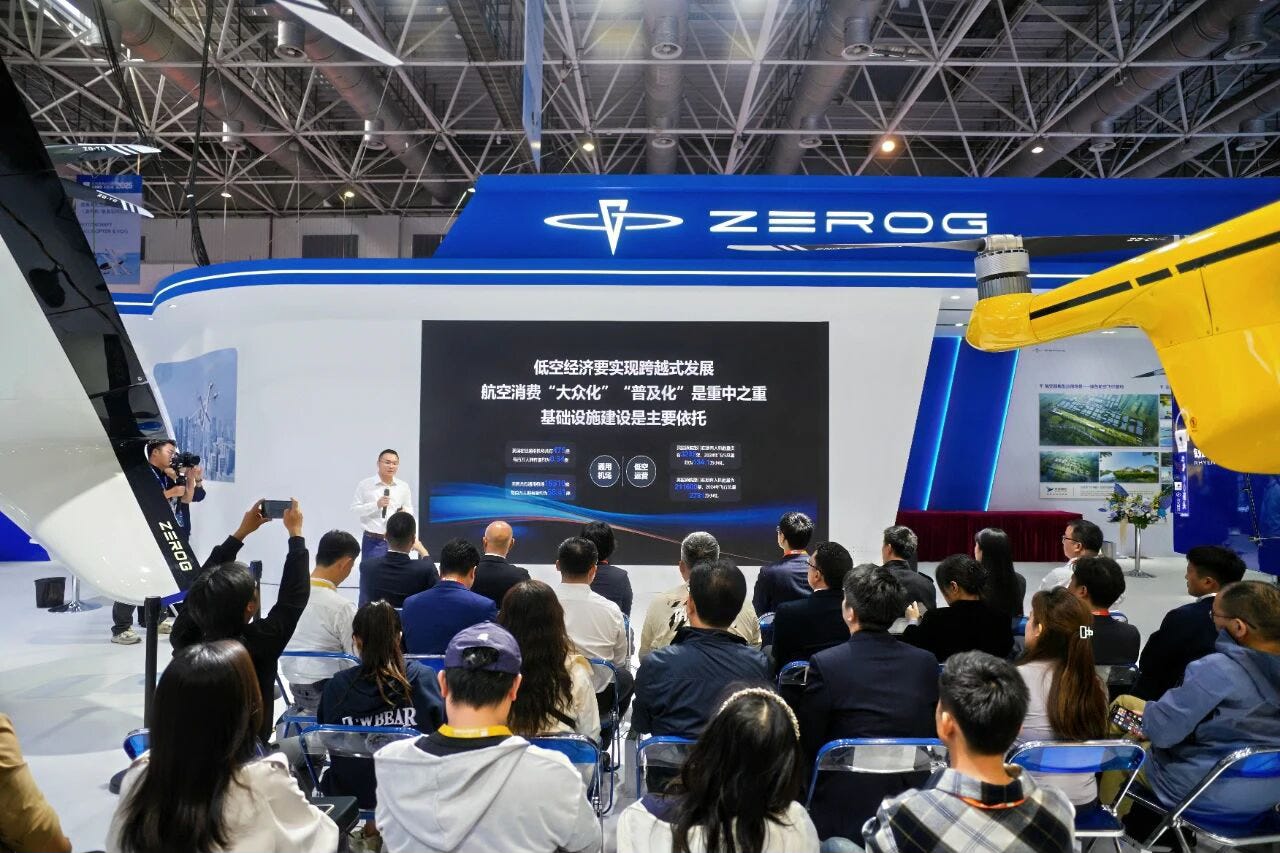
You can read some of my show news at Aviation International News. Video: Aero Asia
Spending time at Aero Asia 2025 offered a front-row seat to some of the most impressive Chinese eVTOL pioneers shaping the country’s aviation future.
Zero Gravity, headquartered in Hefei province, was no exception.
I’ve become an easy fan of the company’s reports, which consistently offer insightful perspectives on China’s emerging low-altitude economy.

What has stood out to me about this startup is not only its technical ambition in next-gen aircraft, but also how active it is in the quieter, often overlooked “civil-servant” side of the industry—helping craft standards, regulations, and research that will underpin sustainable growth.
In Southeast Asia, I often fall back on a simple saying: scarcity breeds necessity—we wear a lot of different hats every day of the week, especially during the building years. Zero Gravity reflects that mindset, pushing forward technically while contributing to the industry’s foundations.
And they’re building a genuinely interesting eCTOL + eVTOL aircraft portfolio.
The Show-stopper: ZG-T6
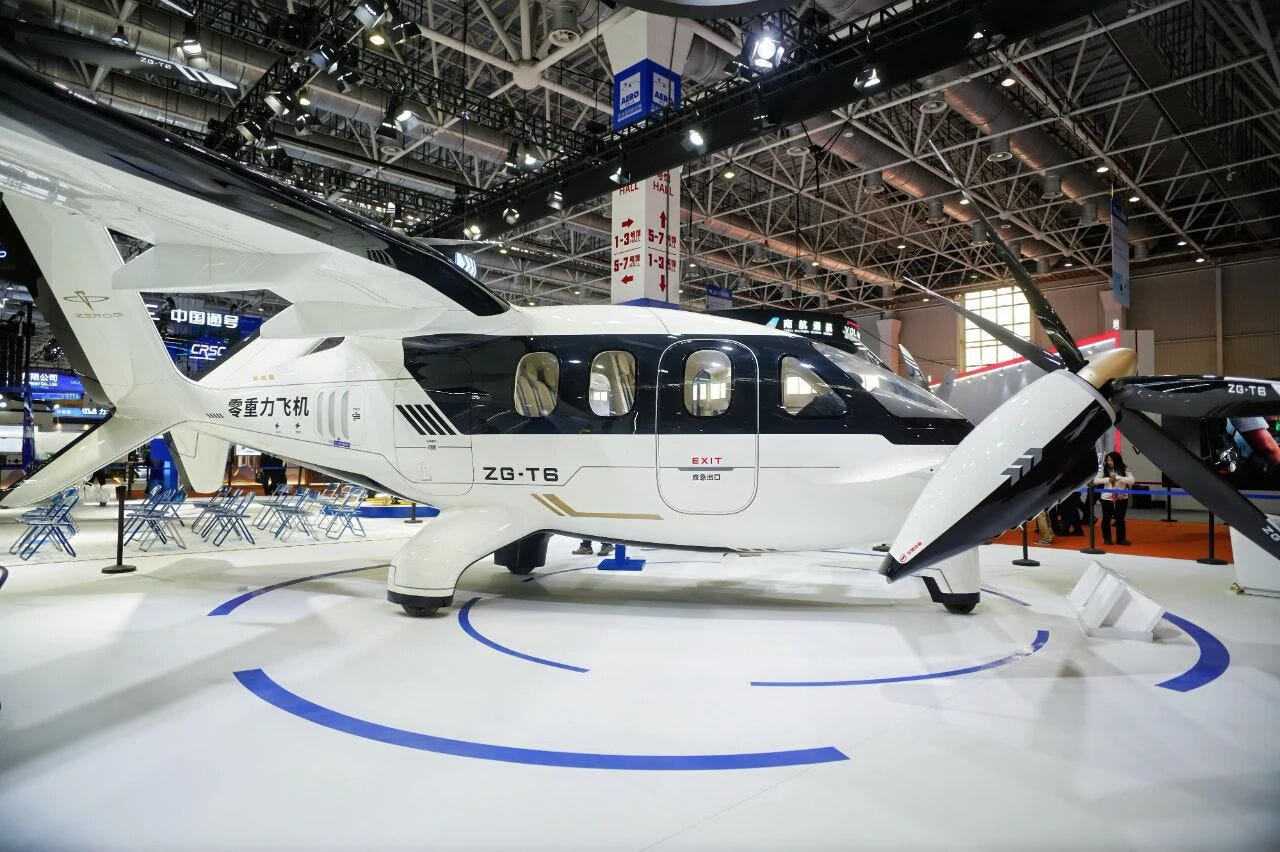
On Aero Asia’s opening day, November 27, Zero Gravity revealed the full-scale engineering demonstrator of its ZG-T6, a six-seat (one pilot + five passenger) eVTOL aircraft described by the company as a tilt-rotor but more accurately classified as a tilt-prop.
According to Zero Gravity, the ZG-T6 represents a step from conceptual design to engineering validation, marking the start of flight testing and airworthiness certification efforts.
The aircraft is earmarked for urban and regional air mobility.
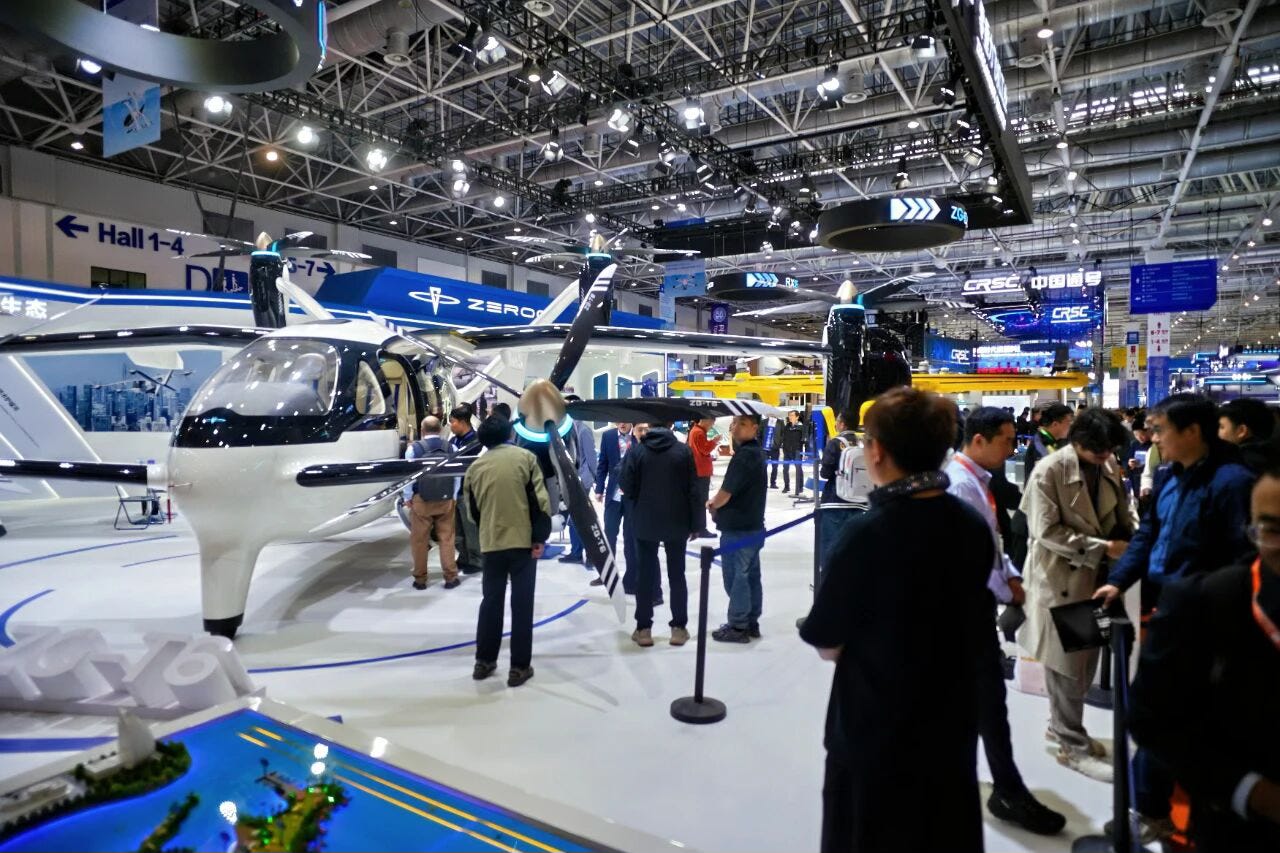
Key Specs—
Maximum takeoff weight (MTOW): 2,500 kg (5,512 lbs)
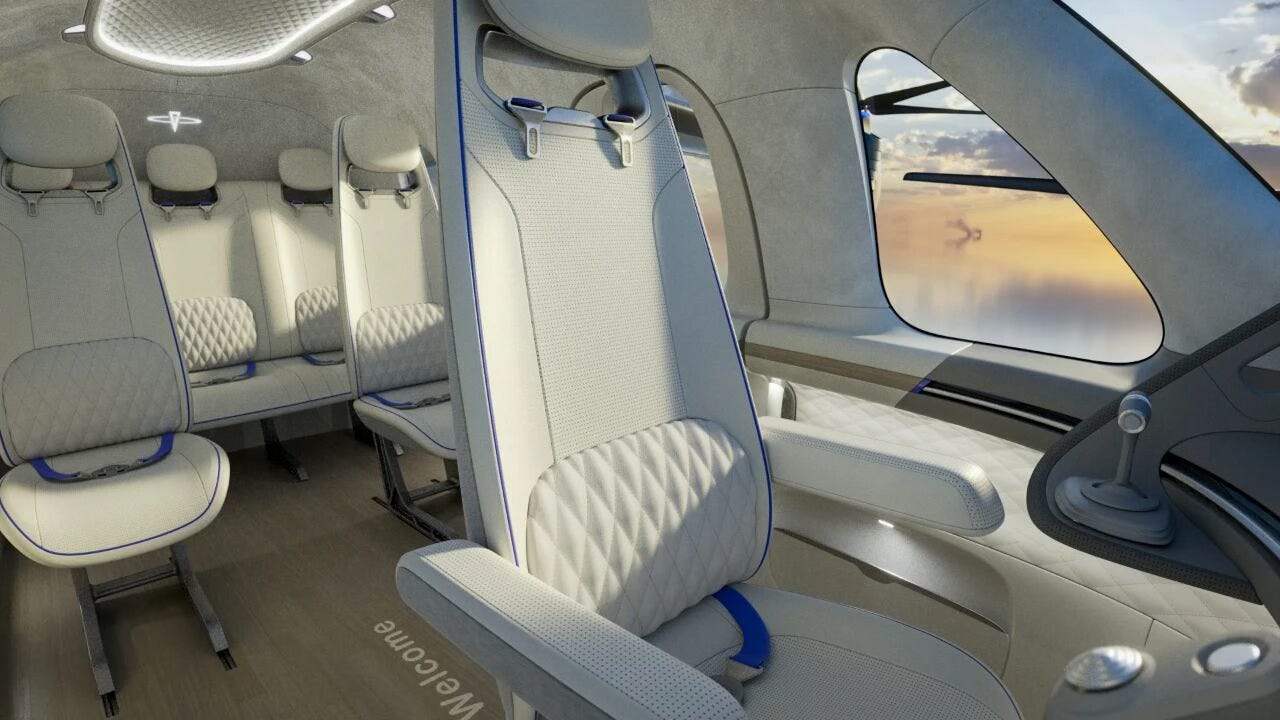
Passenger capacity: 6 (1+5 cabin layout)
Maximum cruising speed: 250 km/h (155 mph)
Range: 300 km (186 mi) or roughly 90 minutes of flight
Dimensions: 10.5 m length (34.4 ft); 15.4 m wingspan (50.5 ft)
Cabin windows: 60 cm × 40 cm (23.6 × 15.7 in) panoramic stargazing windows
Configuration and Aerodynamics:
Three-surface layout: canard + main wing + V-tail
Designed to enhance aerodynamic efficiency while managing noise and reliability
Configurable cabin for passenger transport, cargo, meetings, or rescue operations
Propulsion and Safety Systems:
Dual-winding dual-electric-drive system
Triple-redundant flight control system
Dual-redundant battery management system
Full-chain safety redundancy covering propulsion, control, and energy
Pre-set emergency procedures for single-rotor failure
Video: CCTV
ZG-ONE
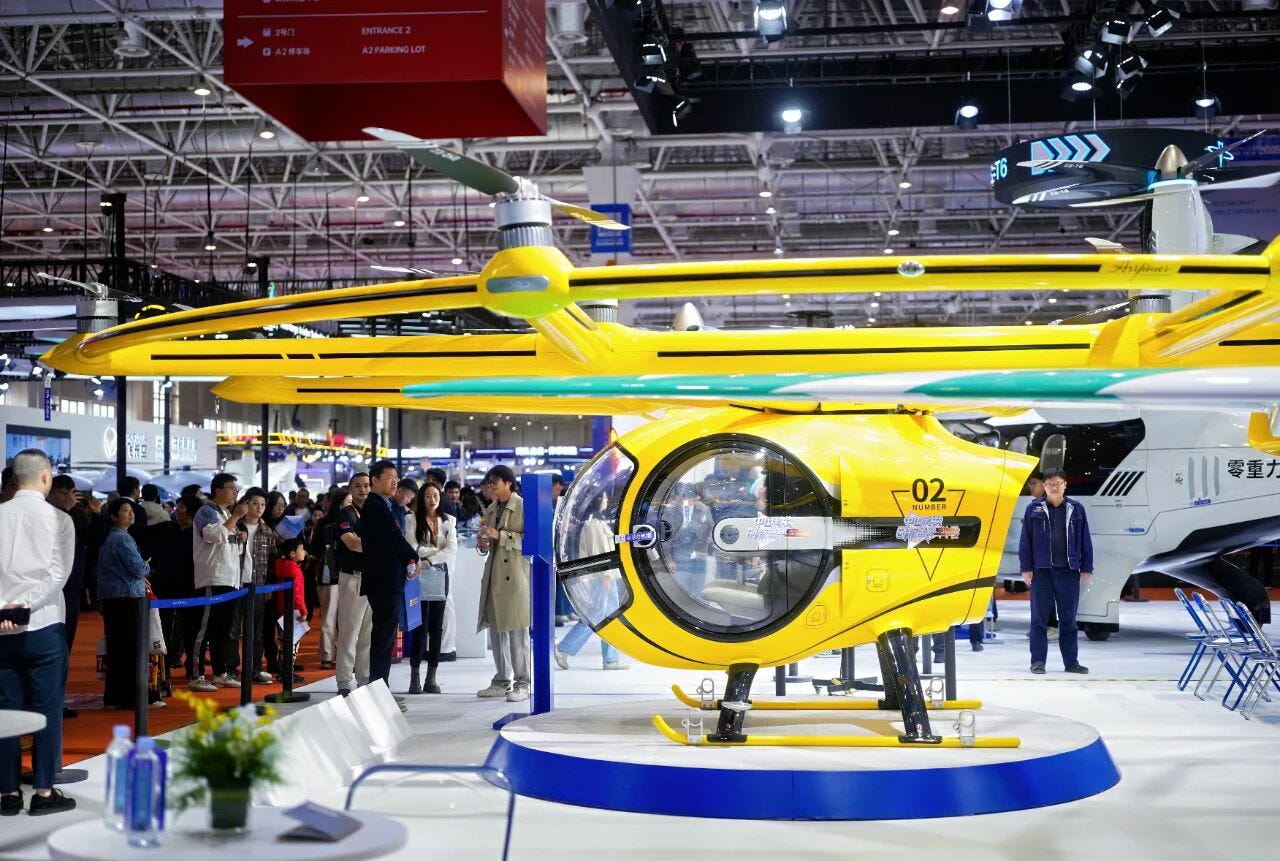
Beyond the ZG-T6, Zero Gravity showcased its broader portfolio of electric aircraft.
The ZG-ONE “Quefei” (translated to Magpie) is a multi-rotor eVTOL designed for urban air mobility and tourism applications.
It has a maximum takeoff weight (MTOW) of 650 kg (1,433 lbs), a two-seat capacity, a cruise speed of 75 km/h (47 mph), and a range of up to 30 km (19 mi).
The ZG-ONE features triple-redundant flight control systems and a whole-aircraft parachute.
The eVTOL successfully completed its first test flight in September 2023, with airworthiness certification and commercial operations expected to begin in 2026.
RX1E-A
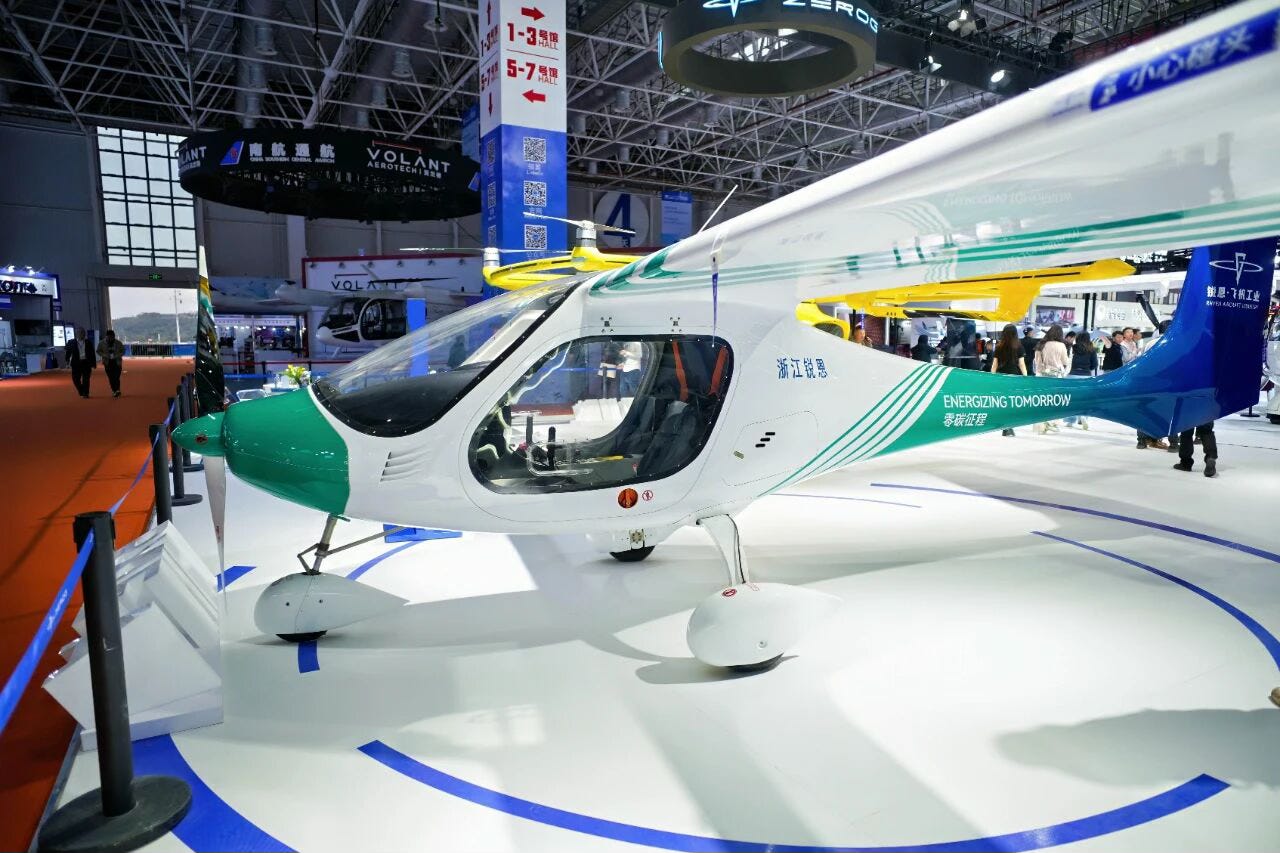
The RX1E-A — China’s first certified electric fixed-wing aircraft for commercial operations — was also on display and snagged orders. We will get into the orders further down.
The RX1E-A is China’s only certified and commercially operational electric light sport aircraft (LSA). Primarily earmarked for pilot training and recreational flying, the RX1E-A is an upgraded version of the RX1E series.
Fully domestically produced, it has a maximum takeoff weight of 630 kg (1,389 lbs), a range of 280 km (174 mi), and a flight time of up to 150 minutes.
It supports flight training and experiential flights and is currently entering scaled operations.
The aircraft completed its maiden flight on November 1, 2017, at Caihu Airport in Shenyang City, the capital of Liaoning Province.
In October 2018, it received its Type Certificate (TC) from the Civil Aviation Administration of China (CAAC). This year it snagged its Production Certificate (PC).

The RX1E-A is produced by Ruien Aircraft Industry (Zhejiang) Co., Ltd.
Zero Gravity is the majority shareholder of Ruien Aircraft Industry, which was established on October 24, 2023, in partnership with Liaoning Ruixiang General Aircraft Manufacturing and Zhejiang Jiaxing Silk Lane Aviation Technology Co., Ltd.
Ruixiang General Aircraft Manufacturing Co., Ltd. is also known as Ruixiang Tongfei. It’s English name is Rhyxeon General Aircraft Co., Ltd.
The aircraft is designed by Shengyang J-8II chief designer Academician Yang Fengtian, who serves as a notable general aviation figure, particular in Liaoning province and at Liaoning General Aviation Academy (LGAA).
LGAA is also involved in the RX-series development.

This August, Zero Gravity entered a strategic cooperation agreement with Jiangsu-based Zenith New Energy Battery Technology to supply aviation-grade power batteries for the RX1E series.
The partnership builds on a broader alliance with Zenith and the Liaoning General Aviation Research Institute to jointly advance the integration of domestic battery, motor, and electronic control technologies for aviation.
With the agreement in place, the RX1E-A and RX1E-S officially entered batch deliveries.
RX1E-S
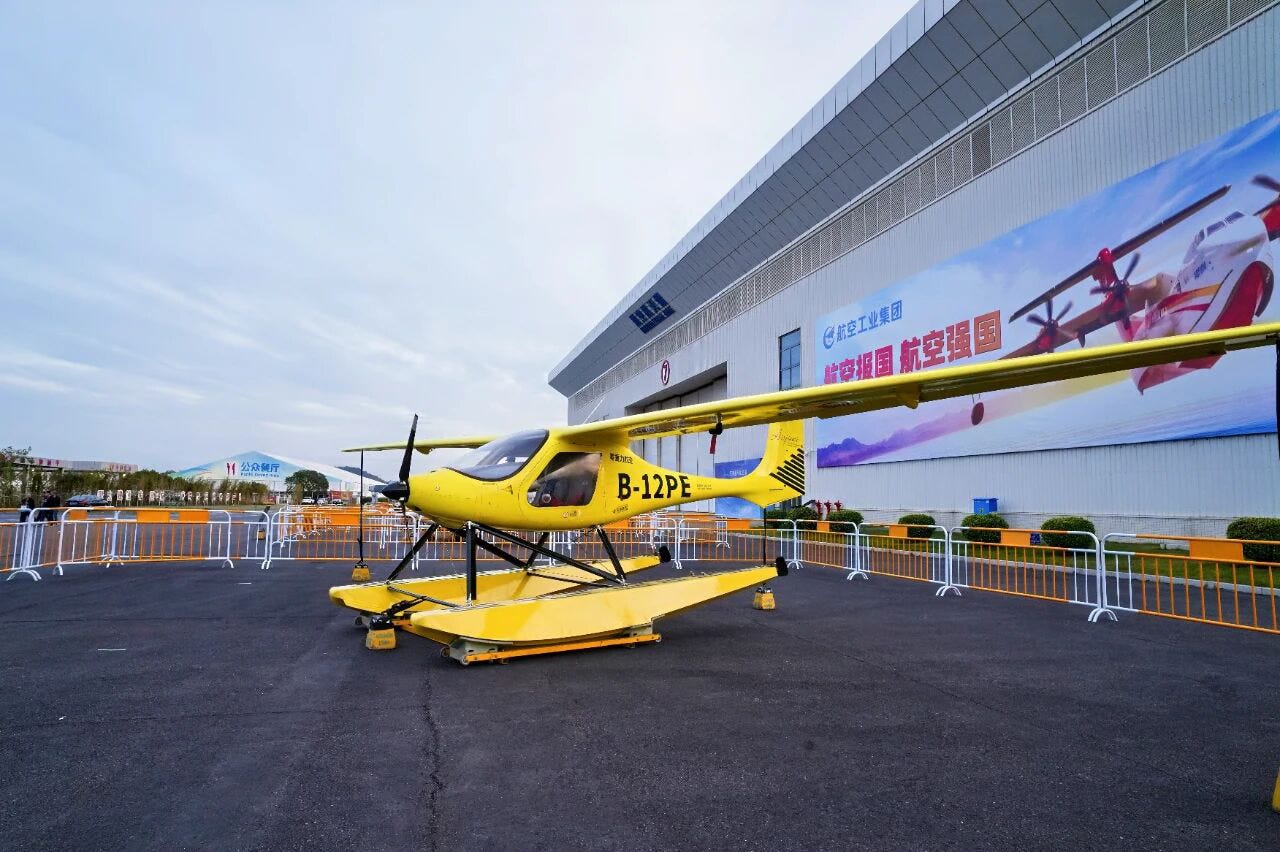
The RX1E-S was also on display, albeit outside the main hall.
The aircraft has a maximum takeoff weight of 650 kg (1,433 lbs) and an empty weight of 500 kg (1,102 lbs). It offers a range of 160 km (99 miles), with a cruising speed of 110 km/h (68 mph) and a maximum speed of 160 km/h (99 mph).
The RX1E-S requires a takeoff run of 235 meters (771 feet) and a landing distance of 207 meters (679 feet). It has a stall speed of 82 km/h (51 mph) and a service ceiling of 3,000 meters (9,843 feet).
Powered by a 50 kWh battery, the RX1E-S delivers a maximum output of 80 kW and has an endurance of 1.5 hours, making it suitable for short to medium-duration flights.
Its dual-pontoon landing gear and retractable water rudders enable takeoff and landing on waterways as short as 200 meters (656 feet).
It is dubbed the world’s first certified float-type, twin-seat electric seaplane.
Video: Zero Gravity
Before we dive into the strategies and deals unveiled at Aero Asia 2025, I’d like to extend my sincere appreciation to the new subscribers who have recently joined China eVTOL News.
In short, this newsletter aims—in part—to gently chip away at the disinformation that too often thrives in echo chambers. My goal is to build a clearer understanding of China’s eVTOL development landscape and where the real opportunities lie.
While English-language coverage of North American and European eVTOL + traditional aviation progress is abundant, credible, in-depth reporting on China’s sector remains scarce.
From my 13 years of covering aviation across the APAC region, I’ve seen how reporting on this part of the world can often be inaccurate, incomplete, and spread thin.
Paid subscriptions directly support this work—helping to sustain independent reporting, access information, and deliver thoughtful analysis that cuts through the noise.
Thank you so much for your trust and support. If you find this newsletter helpful, please share it with others who might be interested.
Strategy + Deals